Showing posts with label New York. Show all posts

Monday, March 5, 2012

Delaware - Finger Lakes, New York, USA

I'm betting that if I asked you where the Delaware grape is from, and if I forced you to hazard a guess, you'd probably say the state of Delaware.  There's a pretty good chance that some of you who have heard of the grape before have just assumed that it's named for the US state (which is itself named for Thomas West, 3rd Baron De La Warr) and not given it a second thought.  That's certainly the conclusion that I naturally jumped to the first time I read about it, and it makes a certain kind of intuitive sense.  Ah, but our intuitions can be dangerous things that often lead us down the road of misinformation, and in this case, would definitely lead us astray if we relied only on them.  No, the Delaware grape is not named for the state of Delaware, but rather for the town of Delaware, located in the state of Ohio.

Why Delaware, Ohio?  Because that's where the grape is from, you might guess.  But, no, the Delaware grape is thought to have originated from the garden of one Paul Provost in Frenchtown, New Jersey.  The story goes that in the early 1800's, a Mr. Warford brought the grapes from New Jersey to Ohio and planted them in his own garden.  At some point, a Mr. Heath also got his hands on cuttings of the grape and both farmers were growing it in 1849 when Abram Thompson, who was editor of the local newspaper in Delaware, Ohio, became aware of it and decided to try to figure out what it was and where it came from.  In 1851 he brought the grape to the attention of the Ohio Pomological Society whose investigations into the grape's origins led them back to Provost's farm, but Provost had passed away in the interim, taking the story of how he acquired the grape with him.  Some claimed that it was brought over by one of Provost's brothers who was living in Italy, which caused the grape to be known as the "Italian wine grape" for awhile.  Others believed the grape came from a German who had spent some time with John Hare Powell in Philadelphia who was an agriculturist as well as a state senator.  Some believed that the German had brought the grape with him from Germany while others believed he picked it up from Powell on his travels.  At the end of the day, though, none of the theories had any evidence to support them, and Occam's Razor ultimately came into effect.  If we can trace the grape back to Provost's farm and no further, it stands to reason that it originated there as a spontaneous field crossing that was grown from seed.

When Thompson first came across the grape, it was generally referred to either as Powell or Heath by the locals.  Thompson sent some of the grapes to AJ Downing, editor of The Horticulturist magazine, who dubbed it Delaware since the samples he received were from the town of Delaware, Ohio.  The grape was added to the American Pomological Society's grape list as a "new variety which promises well."  Two years later it was included in their list of recommended varieties.  The grape was a sensation and was the subject of several articles in the horticultural journals of the time which delighted in debates over its origins and its parentage.  People were so pleased with the quality of wine made from the grape that many thought it must be a 100% vinifera plant at first, but this theory was quickly abandoned.  Pierre-Marie-Alexis Millardet, one of the leading French horticulturists of the time, believed that the grape was likely a hybrid with vinifera, labrusca, cinerea, and aestivalis in its background.  TV Munson, the Texas horitculturist and grape breeder, believed that it was a hybrid of labrusca and bourquiniana grapes with a bit of vinifera thrown in as well.  He further believed that one of the parents was likely a grape called Elsingburgh which was from an area not far from Frenchtown, NJ.  Today, the VIVC indicates that Delaware was likely the result of a vinifera vine crossed with a labrusca x aestivalis hybrid, but no specific grape names are given.

All of the information above is from The Grapes of New York published in 1908 (which you can read in its entirety here).  The section on Delaware begins:

"Delaware is the American grape par excellence. Its introduction raised the standard of quality in our viticulture to that of the Old World, for there is no variety of Vitis vinifera more richly or more delicately flavored or with a more agreeable aroma than the Delaware. This variety is rightly used wherever American grapes are grown as the standard whereby to gauge the quality of other grapes."

The grape was prized for its "constitution which enables it to withstand climatic conditions to which all but the most hardy varieties will succumb, and so elastic as to adapt it to many soils and conditions, and to bear under most situations an abundant crop."  It was considered second only to the Concord grape in terms of its quality as a grape for home gardeners, as a table grape and as a wine grape.  Today, though, Delaware is not held in nearly such high esteem (though it is called "one of the highest quality American varieties for white wine" in an Iowa State horticulture program publication, which is a bit like being called the most beautiful pig at the slaughterhouse).  It is very cold hardy but is also susceptible to a large number of diseases that make it less desirable than some of the newer hybrids.  It is still grown in the Midwest and in some of the cooler regions of New York and used to make wine there, though it is probably most popular in Japan where it is used as a table grape.  

During my trip to the Finger Lakes region of New York a few months back I was able to pick up two bottles made from the Delaware grape from the same producer but in two different styles.  The first wine was the 2009 "Long Stem Pink," a semi-sweet rosé  from Lakewood Vineyards on Seneca Lake which set me back about $8 at the winery.  The Delaware grape has pink skins, as you can see from the photo above, which can impart a pinkish hue to the wine if left in contact with the juice for a short time after pressing.  In the glass, the wine was an orangey salmon pink kind of color.  The nose was moderately aromatic with a simple, one-note grapey kind of aroma.  On the palate the wine was on the fuller side of medium with medium acidity and a sweetness level somewhere north of off-dry but not quite medium sweet.  There were flavors of candied apples, strawberries and wild grapes.  There was a slight bitter edge to it on the finish, but overall it was simple, sweet and fruity which is generally all these kinds of wines aspire to be.  I drank this with a cheddar and chipotle sauced pasta with sausage and broccoli and it performed admirably against the spice and fat of the dish.  If you like sweet table wines with those grapey, "foxy" aromas and flavors, you'll like this a lot, probably, but if you despise and revile those kinds of wines on principle you're probably better off giving this one a pass.

The second wine that I tried was the 2008 "Glaciovinum" from Lakewood Vineyards, which is an ice wine made from Delaware grapes.  It comes in half bottles (375 mL) and costs about $16 at the winery.  In the glass the wine was a fairly deep gold color.  The nose was very aromatic with honey and grapefruit that turns towards those characteristic grapey notes as the wine warms up.  On the palate the wine was medium bodied with fairly high acidity and a very high sweetness level.  There were flavors of honey, ripe grapefruit, apple pie and mandarin oranges when I served the wine right out of the refrigerator.  As the wine warmed up a bit, the grapey labrusca flavors showed up though they never really took over.  Temperature was the key as the second glass I poured myself from the open bottle right out of the fridge showed the same kind of progression.  I was pretty impressed with this wine overall. I thought it was fairly well balanced and had enough going on to keep me interested in it.  The price is what ultimately enticed me into buying a bottle for myself as it can be very difficult to find ice wines for less than $20.  While I probably wouldn't buy the rosé again, I would definitely give this wine another try if I ran across it somewhere for around this price.  I think this wine's labrusca flavors are muted enough that even seasoned labrusca haters might find something to like here.

Monday, February 13, 2012

Noiret - Finger Lakes, New York

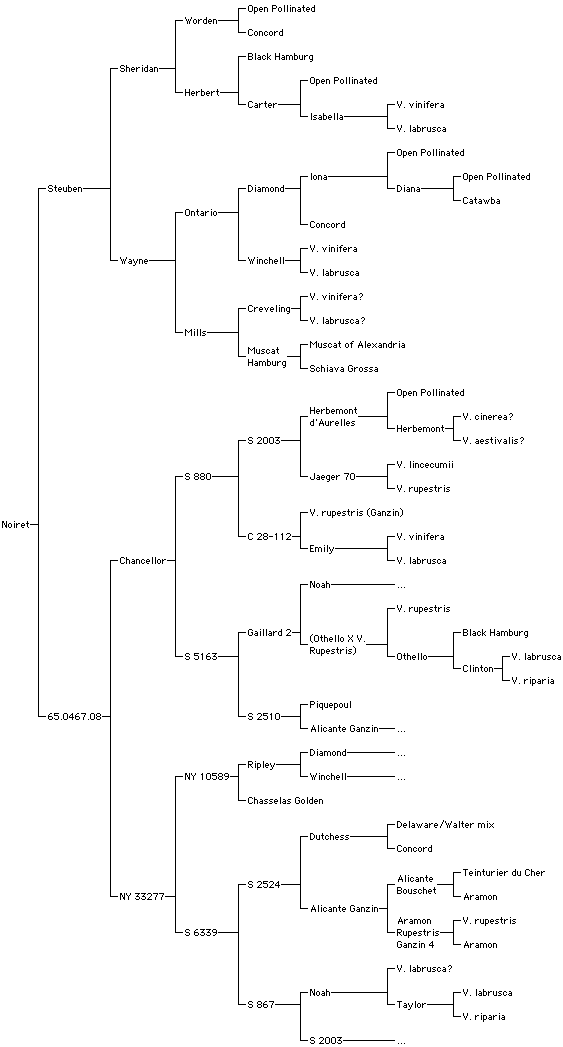
Today's post will be short and sweet because, well, there just isn't a whole lot to say about today's grape.  It's called Noiret and it was released to the public for cultivation only in 2006.  It was created and tested by two Cornell professors named Bruce Reisch and Thomas Henick-Kling at Cornell's New York State Agricultural Experiment Station in Geneva, N.Y.  The original cross (between Steuben and NY65.0467.08) was made in 1973 and first planted in 1975.  They started testing the grape for its winemaking abilities back in 1980 but final approval for commercial sale didn't happen until 2006.  I don't think that the process for all hybrids and crosses takes quite that much time in general, but that does give you some idea of how arduous a task it can be to create new species of grapes.

The grape's family tree is unbelievably complex, but it is also more or less fully mapped out here.  There are a number of familiar faces there as well as a lot of strings of numbers that probably won't mean anything to you unless you are yourself a grape breeder.  They are basically grapes that have been bred at a breeding station but have not been released commercially.  They have various characteristics that are useful for breeding, such as particular disease resistances or weather hardiness, but also have some other flaw that would prohibit their planting on a commercial scale.  Noiret looks to have a very interesting mix of vinifera grapes, hybrid grapes and breeding specimens throughout its family tree.

Like most grapes that are bred at these breeding stations, Noiret was specially bred to have certain characteristics.  It was certainly bred to have some degree of cold hardiness, and it is considered moderately hardy (meaning that the vines will likely survive in conditions between -5 and -15 degrees Fahrenheit).  The only major disease problem listed for Noiret is a moderate susceptibility to downy mildew of the fruit and leaves, meaning that the grower would need to take care in conditions that are conducive to the spread of those fungi.  It has a fairly late bud-break which means that spring frosts aren't really a concern.  The big selling points for the grape are that it is able to impart a deep color to its wines and, best of all, it doesn't have any of the foxiness that can plague some hybrids.

There are some table wines being made from the Noiret grape, but when I was in the Finger Lakes region a few months ago, the only wine I was able to find was a Port-style wine from Red Newt Winery on Seneca Lake.  It's from the 2007 vintage, which I guess either means that they are using very young Noiret grapes for this wine or they have access to vines that may have been planted prior to 2006.  In any case, the blend is 73% Noiret, 20% Syrah and 7% Cabernet Franc and a 500 mL bottle set me back about $24 at the winery.  In the glass the wine was a deep purple ruby color with a very narrow purple rim.  The nose was moderately aromatic with raspberry and blackberry fruits, both fresh and dried, along with some chocolate and raspberry liqueur.  On the palate the wine was medium bodied with fairly high acidity, no tannins, a touch of sweetness and an obviously high alcohol content.  There were flavors of cocoa powder, dried blackberry and black cherry, stewed raspberries, espresso and bittersweet chocolate.  There was also a very distinctive raspberry liqueur flavor that was really dominating the palate.  I found the alcohol a little awkward, mostly because the body really wasn't fleshy enough to prop up the Port alcohol levels.  Overall I found it very enjoyable, though, and enjoyed my bottle with some homemade chocolate-raspberry clafoutis, which it turned out was an excellent pairing.  I hope to be able to track down a table wine made from the grape before too long and will report back when I'm able.

Friday, February 10, 2012

Marechal Foch - Finger Lakes, New York

I'll confess that I have a bit of a soft spot for hybrid grapes.  That's not the kind of admission that you can make in certain company, as the common consensus on hybrid grapes and the wine produced from them is that they are mostly forgettable curiosities made in places where people probably shouldn't bother trying to grow grapes at all.  But that's part of their charm for me.  I love that they allow people in unpleasant (or sometimes downright hostile) climates to grow grapes and make wine.  Sure, you can argue that these wines aren't ever going to blow your mind, but you can also say that about 99% of the wine being made today anyway.  Not every wine has to be  amazing, after all, and if a wine can't be amazing, then I'd prefer that it at least be interesting.  What I like about the hybrids is that even when the wine itself isn't all that interesting (and let's be honest, a lot of it really isn't), there's still a story behind it and how it came into existence.  I realize that that kind of thing may excite me more than most, but I've learned to live with it.

Marechal Foch belongs to a group of grapes that are informally referred to as the French Hybrids. We've taken a look at a few of these hybrids and I've written fairly extensively about their history in my post on the Chambourcin grape, which interested readers are invited to peruse at their leisure.  For those who are fanatical about the proper placement of diacritical marks, I do realize that the grape's proper French spelling is technically Maréchal Foch, but since the French have decided that they're too good for hybrid grapes, I've decided that the Americanized spelling is good enough for me.

Maréchal is the French word for "marshal" and the grape is named for a French general named Ferdinand Foch who was named Maréchal de France in 1918.  Foch was also the Allied Supreme Commander in charge of all French, British and American armies in France during World War I.  He was heavily involved in creating the armistice treaty that ended that war, though he was prescient enough to say at the time "This is not a peace. It is an armistice for twenty years."  Foch himself didn't have anything to do with the creation of the grape that now bears his name. It was created in Alsace which, those of you who are up on your geography know, is located right on the border between France and Germany.  Alsace has gone back and forth between the two countries several times.  It was annexed by Germany in 1871 but France got it back after World War I (and later lost it prior to WWII, regaining it again after that war).  The grape's creator, Eugene Kuhlmann, named it for the great French general as an homage.

Unusually for a hybrid grape, Marechal Foch's parentage isn't precisely known.  Most hybrids are created in laboratory type conditions, so there is usually a lot of documentation for them, but, perhaps because of the precarious location of Alsace through World War II, the documentation for Marechal Foch isn't complete.  Some believe that it is a product of a grape called Goldriesling (itself a cross between Riesling and Courtillier Musqué) and an unidentified vine that was itself a crossing between a v. riparia and a v. rupestris vine.  Others believe that it is the offspring of Pinot Noir and a hybrid called Oberlin 595.  Whatever the case, the grape was commercially introduced in France in 1920 and in the US in 1951, having come over from Canada.  The vine yields small bunches of small grapes which are apparently virtually irresistible to birds.  It is grown to some extent in the Loire Valley, though those grapes cannot legally be used for any commercial wine production.  It does bud early and ripen fairly late, which you would think would make it unpopular in colder regions, but it is grown fairly successfully in Canada and in the Finger Lakes region of New York.

I picked up two wines made from the Marechal Foch grape while traveling in the Finger Lakes a few months back.  The first wine that I picked up was from the Prejean Winery on the western shore of Seneca Lake.  I bought their 2008 vintage Marechal Foch for about $12.  In the glass the wine was an inky, opaque black color with a very narrow purple rim.  The nose was moderately aromatic with juicy blackberry and blueberry fruit along with some smoky charcoal and chocolate and a touch of something meaty and savory.  On the palate the wine was on the fuller side of medium with fairly high acid and very low tannins.  There were flavors of tart cherry, cranberry and blackberry fruit with a touch of smoke and bittersweet chocolate.  The wine was really tart which was surprising given how rich and dark the nose was.  I've noticed with quite a few of these hybrid grape wines that I find their aromatics very appealing, but ultimately find the wines themselves to be sour and a little thin.  This wine definitely followed that pattern.  I have in my notes that this was "all treble and no bass" and that seems like a pretty succinct summary of it.  Even at a paltry $12, there isn't a lot in this wine to recommend it.

The second wine that I picked up was from Atwater Estates on the eastern shore of Seneca Lake.  I bought their 2008 Maréchal Foch, French spelling and all, at the winery for about $24.  In the glass the wine was a deep, inky purple ruby color.  The nose was nicely aromatic with blackberry, black plum and black cherry fruit. There was a distinct meaty, gamy aroma that was really interesting.  On the palate the wine was on the fuller side of medium with fairly high acid and soft tannins.  There were cherry and black plum fruit flavors with smoky, leather undertones.  There was a slightly tart, slightly bitter cherry pit kind of finish to it.  This wine was much deeper and darker than the Prejean and much more balanced overall.  The plush fruits were nicely balanced by the smoky, leathery earthy components.  The bitter finish was a bit too noticeable for my tastes, but overall I really enjoyed this wine.  It's a little expensive for what it is, but it was the best varietal Marechal Foch that I had while I was in the Finger Lakes.  This winery's tasting room is also a pleasure to visit and the pourer was funny and engaging.  It's definitely one of those places and those wines that I'll definitely revisit when I come back to that region.