If the category "Portuguese wine grapes" ever came up on the Family Feud, I'd be willing to bet almost anything that Touriga Nacional would be the number one answer by a fairly substantial margin. Touriga Nacional is known as the Queen of Grapes within Portugal and is that country's answer to Tempranillo or Sangiovese. It is THE main quality grape used in the production of Port and, in more recent years, has taken on a larger role in the production of dry table wines in the Douro and Dão regions of Portugal. While it may not be a household name right now, it is a grape that is fairly well known to experienced wine drinkers and which can be had quite easily from virtually any shop. So why write about it here? Because this particular bottle came from grapes grown in Pennsylvania.
Before we get to that, let's talk a little about the grape itself. Despite Touriga's reputation as the highest quality wine grape in Portugal and despite the fact that Touriga Nacional and Portuguese wines are practically synonymous at this point, it wasn't that long ago that the grape was on the brink of extinction. The vine is prone to poor fruit set and, when the fruit actually does set, it sets into a small number of small clusters with small berries. This means that the wines made from these grapes are uniquely deep in color and intensely flavorful and aromatic, but it also means that the vines produce pitifully small yields, which is not a quality that growers are enamored of in the vines that they cultivate. Despite that, by around 1900, Touriga Nacional was thought to cover over 90% of the vineyard land in the Dão. As we've seen so many times, though, once Phylloxera came to town, everything changed. After the scourge had decimated their vineyards, many growers decided to plant higher yielding vines that they could get more juice (and therefore more wine) from. The vine was perilously close to disappearing in the mid 20th Century but it hung on. Today it only accounts for about 2% of the vines of the Douro Valley and possibly up to 20% of the vines of the Dão. Given its rising popularity on the international scene, its plantings are increasing and the vine is finding its way south through Portugal, but not all that quickly. It is currently planted on about 3500 hectares (about 9000 acres) throughout Portugal.
The name Touriga may come from a village in the Dão called Tourigo, where the grape is thought to have originated. The Nacional part means exactly what you'd think, and I'd be interested to find out how it got tacked on at the end. There are a host of other Touriga grapes such as Touriga Franca, Touriga Branca and Touriga Fêmea which, as far as I can tell, aren't related to one another, but the two most widely planted are Nacional and Franca. Touriga Franca used to be known as Touriga Francesa, which means French Touriga basically, though the grape doesn't appear to be from France. My guess is that both grapes were thought to be from around Tourigo, but, for some reason, Touriga Franca was thought to have come from France before then, while Touriga Nacional was thought to be indigenous to the area. The Nacional was tacked on to indicate that it was a native Portuguese grape as opposed to a grape imported from another country that happened to land near Tourigo. As for the other two Tourigas, Branco means white, so you can guess how that it got its name, while a synonym for Touriga Fêmea (while means "female Touriga") is Touriga Brasileira, which may indicate that the locals thought there may be some kind of connection with Brazil (which was a Portuguese colony for many years). All of that is conjecture, though, and I'd be interested to hear from anyone who may know more.
Touriga Nacional is grown outside of Portugal, but like most Portuguese wine grapes, it hasn't made a big splash anywhere outside of its home country. There is some grown in Spain, Australia and a very little bit is grown in the United States. The grape really seems to thrive in the intense heat and poor, rocky soils of the Douro valley, so when my sister gave me a bottle of Touriga Nacional from a winery in Pennsylvania for Christmas, I was pretty surprised. The winery is Paradocx Vineyards and they're located in Landenberg, PA, which is in the southeastern corner of Pennsylvania, very near Wilmington, Delaware. My only prior exposure to this winery was when my wife went to a wine festival in Pennsylvania with her siblings a few years ago and came home with a paint can full of 3.5 liters of wine. I've written on other sites about my frustration with wineries trying to grow grapes that are climactically poorly suited to their region, and while I don't necessarily want to run through that argument again, it certainly looked like this might be a prime example of that phenomenon. It turns out that Landenberg isn't that much different from the Douro Valley in terms of latitude, but I don't know enough about the climates of the two regions to be able to say how similar or dissimilar they are (my gut tells me Portugal is hotter and drier, but I wouldn't swear to it). I'm certain that the hills of Southern Chester County Pennsylvania aren't as steep and rocky as the vineyards of the Douro, though, so I was curious to see what the wine would be like.
As I mentioned, my sister in law gave me a bottle of the 2010 Paradocx Vineyards Touriga Nacional, which it looks like retails for about $29 on the winery's website. In the glass the wine was a pale ruby color that looked more like Pinot Noir than Touriga Nacional. As mentioned above, the berries of Touriga Nacional are very small which usually produces a very deeply colored wine, but I could easily see through this wine, which wasn't necessarily a promising start. The nose was nicely aromatic with spicy, dusky red cherry and raspberry fruit with a bit of wild strawberry, tea leaves and damp earth. On the palate the wine was medium bodied with medium acidity and low tannins. There were flavors of spicy cherry and raspberry fruit with strong black tea and damp earth notes. The more I smelled and drank this, the more concerned I was that maybe I just had Pinot Noir on the brain, but my wife confirmed most of my taste sensations.
This is kind of a hard wine to talk about. It wasn't a bad wine as far as wines go. If I had been served this without any idea of what it was, I would have found it quite enjoyable and probably would have guessed that it was a cool climate Pinot Noir based wine. With no information other than the juice in the glass, I would say it was a decent wine but not necessarily something I'd rush out to buy again. But if you consider it as an example of a wine made from Touriga Nacional grapes, it feels like the conclusion that you come to about its quality has to be radically different. As an example of a Touriga Nacional wine, it's a very bad wine as it lacks virtually all of the characteristics that you would expect to see in a wine made from that grape. It is light and delicate where Touriga is brawny and intense. It is marked by low color, low tannins and red berryish fruit where Touriga is deeply colored, fiercely tannic and loaded with black fruits.
So is the wine good or bad? What can we really say about this wine? When we had no information, we found it enjoyable, but learning additional information about the wine has prejudiced us and caused us to think about it in a different, more negative light. Is our first sensation of enjoyment the most important one or should our critical estimation arrived at after considering all of the important facts of the matter be privileged? Has the additional knowledge poisoned the well, so to speak, or has it given us a deeper perspective and allowed us to see something closer to the truth?
Showing posts with label Red Wine. Show all posts
Monday, March 12, 2012
Friday, February 17, 2012
Prieto Picudo - Castilla Y León, Spain
Prieto Picudo is not a very interesting grape. I know that's not the best way to get you interested in reading more about it, but as far as I can tell, it's the honest truth. The Wikipedia page for it is not only not informative and very short, but it was almost certainly written by either the winery whose bottle is shown in the picture or by some other kind of PR organization with a pretty shaky grasp on the English language. The entry in the Oxford Companion to Wine isn't much better (though, as you might expect, their English is impeccable). They tell us that the grape is grown on about 5,000 hectares of land around the city of León in northwestern Spain. Further, the grape is "unusual," "musky," and "light in color but very distinctive." It is permitted for use in the Tierra de León, Valles de Benavente, Valtiendas DO regions, but a good deal of the production is bottled under the Vino de la Tierra Castilla y León heading, which is essentially the Spanish equivalent to a Vin de Pays in France or an IGT in Italy. Why much of the wine is relegated to this lower quality rung is a question that isn't explored or answered.
Aside from that, there isn't much to say. A comment left on the VINEgeek site informs us that the word Prieto means "dark," referring to the fact that it is a dark-skinned grape, and Picudo means "peaked," which refers to the sharp taper at the bottom of the bunches. The always excellent Catavino adds that the grape is thought to be native to the León region of Spain and there are at least two clonal variants of Prieto Picudo: one with oval-shaped berries and one with round berries with the latter type being preferred for wine-making. Interestingly, that post from Catavino is from 2005 and the writer there seems pretty excited about the possibilities for Prieto Picudo given the wines that he tasted. In 2010, a different writer for Catavino was much less enthusiastic, saying in reference to six different Prieto Picudo based wines that he had recently tried: "To just about anyone, they were awful." To be clear, he wasn't slamming Prieto Picudo as a varietal, as he does say later in the pieces that he has had some good examples. His concern is more with the wineries, or at least the wineries represented in this particular tasting, and their improper treatment of the grape once it leaves the vine. Without knowing exactly which wines he tasted and exactly what their sin was, it's hard to come a judgement of one's own, though.
And that's about it. There is a shocking lack of up-to-date books on Spanish wine, and the only older book that I have (the 1999 edition of Julian Jeffs' The Wines of Spain) doesn't make any mention of Prieto Picudo at all. I've only seen wines made from the grape in one wine shop in the Boston area (Marty's in Newton) within the last year, but, weirdly, they had two different examples. The one that I bought was the 2006 Dominio Dostares "Estay" from Castilla Y León, and I paid about $16 for it. In the glass the wine was a fairly deep purple ruby color that was nearly opaque at the core. The nose was moderately aromatic with red cherry, strawberry and red berry fruit along with some baking spice, chocolate and smoke. On the palate the wine was medium bodied with medium acidity and low tannins. There were flavors of red cherries and both stewed and fresh, brambly red berry fruit (as an aside, the tasting note "red berry fruit" makes me a little uncomfortable as I try to be as precise as I can, but sometimes I just have a vague sense of fruit that is red and berryish which doesn't announce its presence in a more assertive way, so "red berry fruit" it is). There was also a touch of baking spice and a kind of cedar-y woodiness as well. As it opened up, it picked up something that I've never really been able to put a name to, but which is always unwelcome in my glass. The closest I can come to describing it is that it tastes kind of like the strawberry flavor of those awful candies that Life Savers makes called Creme Savers. In my notes I write "strawberries and cream," but it's that artificial kind of cream that those candies had (or, similarly, like the artificial cream flavor in Cream Soda soft drinks). I've picked it up in red wines made from a variety of grapes, so I'm guessing it's something that happens during the winemaking process, but when it shows up, it's a total deal-breaker for me. This wine wasn't the worst offender that I've ever tasted, but that flavor was there. I'm willing to try another example of wine made from this grape from another producer, but I probably won't go out of my way to seek one out or pick one up.
Aside from that, there isn't much to say. A comment left on the VINEgeek site informs us that the word Prieto means "dark," referring to the fact that it is a dark-skinned grape, and Picudo means "peaked," which refers to the sharp taper at the bottom of the bunches. The always excellent Catavino adds that the grape is thought to be native to the León region of Spain and there are at least two clonal variants of Prieto Picudo: one with oval-shaped berries and one with round berries with the latter type being preferred for wine-making. Interestingly, that post from Catavino is from 2005 and the writer there seems pretty excited about the possibilities for Prieto Picudo given the wines that he tasted. In 2010, a different writer for Catavino was much less enthusiastic, saying in reference to six different Prieto Picudo based wines that he had recently tried: "To just about anyone, they were awful." To be clear, he wasn't slamming Prieto Picudo as a varietal, as he does say later in the pieces that he has had some good examples. His concern is more with the wineries, or at least the wineries represented in this particular tasting, and their improper treatment of the grape once it leaves the vine. Without knowing exactly which wines he tasted and exactly what their sin was, it's hard to come a judgement of one's own, though.
And that's about it. There is a shocking lack of up-to-date books on Spanish wine, and the only older book that I have (the 1999 edition of Julian Jeffs' The Wines of Spain) doesn't make any mention of Prieto Picudo at all. I've only seen wines made from the grape in one wine shop in the Boston area (Marty's in Newton) within the last year, but, weirdly, they had two different examples. The one that I bought was the 2006 Dominio Dostares "Estay" from Castilla Y León, and I paid about $16 for it. In the glass the wine was a fairly deep purple ruby color that was nearly opaque at the core. The nose was moderately aromatic with red cherry, strawberry and red berry fruit along with some baking spice, chocolate and smoke. On the palate the wine was medium bodied with medium acidity and low tannins. There were flavors of red cherries and both stewed and fresh, brambly red berry fruit (as an aside, the tasting note "red berry fruit" makes me a little uncomfortable as I try to be as precise as I can, but sometimes I just have a vague sense of fruit that is red and berryish which doesn't announce its presence in a more assertive way, so "red berry fruit" it is). There was also a touch of baking spice and a kind of cedar-y woodiness as well. As it opened up, it picked up something that I've never really been able to put a name to, but which is always unwelcome in my glass. The closest I can come to describing it is that it tastes kind of like the strawberry flavor of those awful candies that Life Savers makes called Creme Savers. In my notes I write "strawberries and cream," but it's that artificial kind of cream that those candies had (or, similarly, like the artificial cream flavor in Cream Soda soft drinks). I've picked it up in red wines made from a variety of grapes, so I'm guessing it's something that happens during the winemaking process, but when it shows up, it's a total deal-breaker for me. This wine wasn't the worst offender that I've ever tasted, but that flavor was there. I'm willing to try another example of wine made from this grape from another producer, but I probably won't go out of my way to seek one out or pick one up.
Wednesday, February 15, 2012
Weird Blend Wednesday - Nielluccio, Sciacarello, Syrah and Grenache - Corse Calvi, Corsica, France
![]() |
| Nielluccio Grapes |
For many years, there was controversy and disagreement surrounding the Nielluccio grape, with the main point of contention centered around questions concerning its origins. One camp held that the grape was indigenous to the island of Corsica, while the other held that the grape was imported there from the Italian mainland during the time that it was under the control of the Genoese. Oz Clarke is purportedly a proponent of the former position (in his Grapes and Wines which was published several years back, so his position may have changed) while Jancis Robinson is a proponent of the latter, having recently switched over from the indigenous camp. In the beginning, both camps were arguing under the assumption that Nielluccio was a distinct grape variety that could not be found anywhere else. Later on, it was determined that Nielluccio was ampelographically identical to the Sangiovese grape, and many began to speculate that the grapes were either very closely related or, possibly, even identical (or clonally variant at least). To read the Wikipedia entry on Nielluccio, one would think that the debate is still raging and the answer is still to be determined. It is not.
A research group from Bologna, Italy, published a study in 2005 which compared the DNA of 39 registered Sangiovese clones as well as 34 "biotypes" of Sangiovese to the acknowledged "reference standard" of Sangiovese to see if there were any differences. The 39 clones all came back as identical both to one another and to the reference standard, while of the 34 biotypes, all but six were identical as well. Nielluccio was not one of the six, meaning that it is genetically identical to Sangiovese. Of the preceding argumentative positions regarding Niellucio, this finding really only completely discredits the one that holds that Nielluccio is indigenous to Corsica, since we know Sangiovese is not ultimately a Corsican grape. The theory that the Genoans brought it over at some point during their rule of the island is still a possibility, though, and is currently the most widely accepted explanation of Nielluccio's presence on Corsica, where, as of the year 2000, it was planted on about 1600 hectares of land, representing about 14% of the total plantings within Corsica.
![]() |
| Sciacarello Grapes |
I was unsure whether I would write about this wine or not since it is mostly comprised of relatively common grapes, but the fact that the wine was from Corsica was what finally swayed me. Corsican wine isn't incredibly rare, but it isn't exactly common either. Corsica itself is the fourth largest island in the Mediterranean, which, while it belongs politically to the French, is much closer to Italy both geographically and culturally. It is less than 7 miles north of Sardinia and 56 miles west of Tuscany, but is about 105 miles away from the Provençal coast of France. It was controlled by the Republic of Genoa for over 500 years, from the mid-13th Century until well into the 18th Century. The Genoans enacted strict rules on viticulture and viniculture and would not allow the Corsicans to ship their wine to any port outside of Genoa. The Corsicans struggled for their independence, and in 1755 proclaimed themselves sovereign as The Corsican Republic with the publication of the Corsican Constitution. The Genoans didn't really want to deal with this kind of trouble so in 1764 they secretly sold the island to France. The French slowly began to build up their presence on the island until 1768 when the Genoans openly announced that they were ceding the island to the French in perpetuity with no possibility of retraction. The Corsicans revolted at the news but were ultimately defeated and the island was officially annexed onto France in 1770. Napoleon was born in Ajaccio, Corsica, in August of 1769, and one wonders how much differently history may have played out if Napoleon's home had not been transferred to France when it was.
The wine history of Corsica goes back thousands of years. It is thought that there may have been some indigenous vines on Corsica, but when the Phoenicians settled the island, they certainly brought many of their own vines from their other territories. Corsica came under Islamic rule around the 7th and 8th Centuries AD, and since the Islamic religion forbids the consumption of alcohol, the winemaking industry on the island suffered badly. It rebounded significantly under Genoan rule, becoming famous throughout the European world, but was still limited by the Genoans strict control over the entire industry. The Genoans definitely had the largest impact on the wine culture of the island, as can be seen in the wealth of Italian grapes that are still cultivated all over Corsica today. The government sought to expand the Corsican economy in the 19th Century by focusing on winemaking, but the plan was derailed severely with the onset of Phylloxera. When vines were finally replanted, many of them were planted to productive but bland French grapes like Carignan and Cinsaut and Corsica became a significant contributor to the European wine lake. The EU vine-pull subsidies of the 1980's were very successful in Corsica, eliminating about 7000 hectares of low-quality vines and putting the focus more on higher quality grapes like Nielluccio, Sciacarello, Vermentino and some of the international varieties.
The wine that I picked up was from the Calvi sub-region of the island, located in the extreme northwest corner near the town of Calvi (just north of Ajaccio, where Napoleon's family made wine). The soils here are predominantly schist with some granite. The island is generally warm and sunny with regular rainfall, but very little rain during August and September, which usually creates ideal conditions for harvest. The AOC rules stipulate that to qualify for the Corse Calvi designation, the finished wine must be made up of at least 50% Nielluccio, Sciacarello and/or Grenache together, while Barbarossa, Carignan, Cinsaut, Mourvedre, Syrah and Vermentino combined cannot account for more than 50% of the total blend with the further restriction that Vermentino and Carignan cannot make up more than 20% of the blend.
I picked up a bottle of the 2007 Domaine Maestracci "E Prove" Corse Calvi wine from my friends at the Spirited Gourmet for about $17. The wine manager there told me the wine was about 1/3 Nielluccio, 1/3 Grenache, 1/6 Syrah and 1/6 Sciacarello. In the glass the wine was a fairly deep purple-ruby color. The nose was moderately aromatic with dusky black cherry and black plum fruits with some wet leather and cocoa powder. It was a very nice and appealing mixture of fruit and earth. On the palate the wine was medium bodied with fairly high acid and some fairly serious tannins. There were flavors of bright red and black cherry fruit with some blackberry, smoke, leather and tobacco. Right after opening the fruits are predominantly red, but as the wine opens up they shift over to a darker, more brooding kind of character. The whole way through, though, the wine is marked by an excellent balance between its vibrant fruit and duskier earthy flavors all held together with a solid vein of acidity and tannic skeleton. The wine is enjoyable enough to drink on its own but it really does need food to truly show its stuff. Any red meat would be fine, while the acid means that it could stand up to fattier meats or sauces as well as tomato-based sauces. The wine is versatile enough where you really don't have to over-think the pairing and at only $17, you can buy a few bottles to have on hand anytime.
Monday, February 13, 2012
Noiret - Finger Lakes, New York
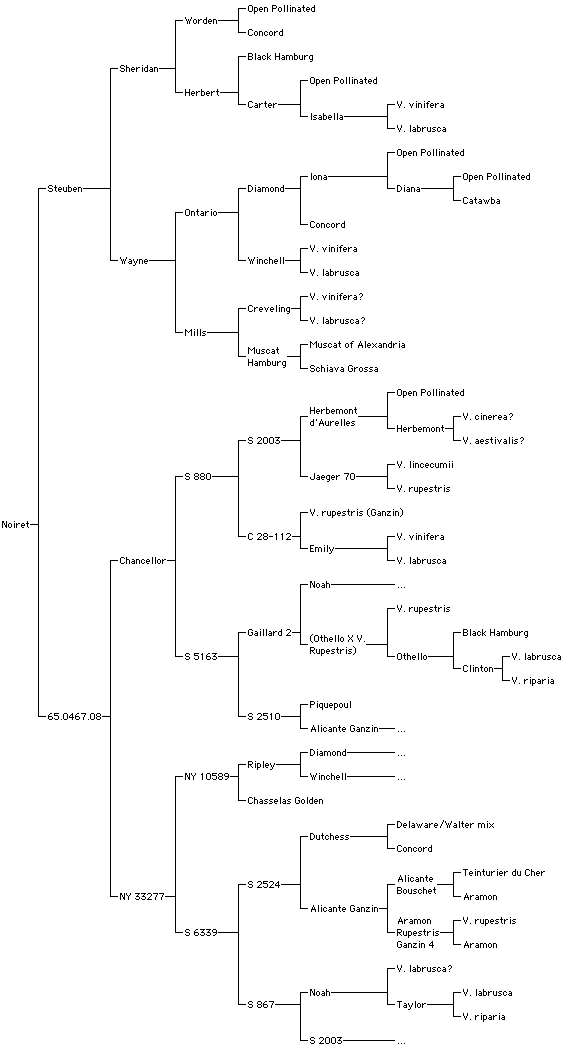
Today's post will be short and sweet because, well, there just isn't a whole lot to say about today's grape. It's called Noiret and it was released to the public for cultivation only in 2006. It was created and tested by two Cornell professors named Bruce Reisch and Thomas Henick-Kling at Cornell's New York State Agricultural Experiment Station in Geneva, N.Y. The original cross (between Steuben and NY65.0467.08) was made in 1973 and first planted in 1975. They started testing the grape for its winemaking abilities back in 1980 but final approval for commercial sale didn't happen until 2006. I don't think that the process for all hybrids and crosses takes quite that much time in general, but that does give you some idea of how arduous a task it can be to create new species of grapes.
The grape's family tree is unbelievably complex, but it is also more or less fully mapped out here. There are a number of familiar faces there as well as a lot of strings of numbers that probably won't mean anything to you unless you are yourself a grape breeder. They are basically grapes that have been bred at a breeding station but have not been released commercially. They have various characteristics that are useful for breeding, such as particular disease resistances or weather hardiness, but also have some other flaw that would prohibit their planting on a commercial scale. Noiret looks to have a very interesting mix of vinifera grapes, hybrid grapes and breeding specimens throughout its family tree.
Like most grapes that are bred at these breeding stations, Noiret was specially bred to have certain characteristics. It was certainly bred to have some degree of cold hardiness, and it is considered moderately hardy (meaning that the vines will likely survive in conditions between -5 and -15 degrees Fahrenheit). The only major disease problem listed for Noiret is a moderate susceptibility to downy mildew of the fruit and leaves, meaning that the grower would need to take care in conditions that are conducive to the spread of those fungi. It has a fairly late bud-break which means that spring frosts aren't really a concern. The big selling points for the grape are that it is able to impart a deep color to its wines and, best of all, it doesn't have any of the foxiness that can plague some hybrids.
There are some table wines being made from the Noiret grape, but when I was in the Finger Lakes region a few months ago, the only wine I was able to find was a Port-style wine from Red Newt Winery on Seneca Lake. It's from the 2007 vintage, which I guess either means that they are using very young Noiret grapes for this wine or they have access to vines that may have been planted prior to 2006. In any case, the blend is 73% Noiret, 20% Syrah and 7% Cabernet Franc and a 500 mL bottle set me back about $24 at the winery. In the glass the wine was a deep purple ruby color with a very narrow purple rim. The nose was moderately aromatic with raspberry and blackberry fruits, both fresh and dried, along with some chocolate and raspberry liqueur. On the palate the wine was medium bodied with fairly high acidity, no tannins, a touch of sweetness and an obviously high alcohol content. There were flavors of cocoa powder, dried blackberry and black cherry, stewed raspberries, espresso and bittersweet chocolate. There was also a very distinctive raspberry liqueur flavor that was really dominating the palate. I found the alcohol a little awkward, mostly because the body really wasn't fleshy enough to prop up the Port alcohol levels. Overall I found it very enjoyable, though, and enjoyed my bottle with some homemade chocolate-raspberry clafoutis, which it turned out was an excellent pairing. I hope to be able to track down a table wine made from the grape before too long and will report back when I'm able.
The grape's family tree is unbelievably complex, but it is also more or less fully mapped out here. There are a number of familiar faces there as well as a lot of strings of numbers that probably won't mean anything to you unless you are yourself a grape breeder. They are basically grapes that have been bred at a breeding station but have not been released commercially. They have various characteristics that are useful for breeding, such as particular disease resistances or weather hardiness, but also have some other flaw that would prohibit their planting on a commercial scale. Noiret looks to have a very interesting mix of vinifera grapes, hybrid grapes and breeding specimens throughout its family tree.
Like most grapes that are bred at these breeding stations, Noiret was specially bred to have certain characteristics. It was certainly bred to have some degree of cold hardiness, and it is considered moderately hardy (meaning that the vines will likely survive in conditions between -5 and -15 degrees Fahrenheit). The only major disease problem listed for Noiret is a moderate susceptibility to downy mildew of the fruit and leaves, meaning that the grower would need to take care in conditions that are conducive to the spread of those fungi. It has a fairly late bud-break which means that spring frosts aren't really a concern. The big selling points for the grape are that it is able to impart a deep color to its wines and, best of all, it doesn't have any of the foxiness that can plague some hybrids.
There are some table wines being made from the Noiret grape, but when I was in the Finger Lakes region a few months ago, the only wine I was able to find was a Port-style wine from Red Newt Winery on Seneca Lake. It's from the 2007 vintage, which I guess either means that they are using very young Noiret grapes for this wine or they have access to vines that may have been planted prior to 2006. In any case, the blend is 73% Noiret, 20% Syrah and 7% Cabernet Franc and a 500 mL bottle set me back about $24 at the winery. In the glass the wine was a deep purple ruby color with a very narrow purple rim. The nose was moderately aromatic with raspberry and blackberry fruits, both fresh and dried, along with some chocolate and raspberry liqueur. On the palate the wine was medium bodied with fairly high acidity, no tannins, a touch of sweetness and an obviously high alcohol content. There were flavors of cocoa powder, dried blackberry and black cherry, stewed raspberries, espresso and bittersweet chocolate. There was also a very distinctive raspberry liqueur flavor that was really dominating the palate. I found the alcohol a little awkward, mostly because the body really wasn't fleshy enough to prop up the Port alcohol levels. Overall I found it very enjoyable, though, and enjoyed my bottle with some homemade chocolate-raspberry clafoutis, which it turned out was an excellent pairing. I hope to be able to track down a table wine made from the grape before too long and will report back when I'm able.
Friday, February 10, 2012
Marechal Foch - Finger Lakes, New York
I'll confess that I have a bit of a soft spot for hybrid grapes. That's not the kind of admission that you can make in certain company, as the common consensus on hybrid grapes and the wine produced from them is that they are mostly forgettable curiosities made in places where people probably shouldn't bother trying to grow grapes at all. But that's part of their charm for me. I love that they allow people in unpleasant (or sometimes downright hostile) climates to grow grapes and make wine. Sure, you can argue that these wines aren't ever going to blow your mind, but you can also say that about 99% of the wine being made today anyway. Not every wine has to be amazing, after all, and if a wine can't be amazing, then I'd prefer that it at least be interesting. What I like about the hybrids is that even when the wine itself isn't all that interesting (and let's be honest, a lot of it really isn't), there's still a story behind it and how it came into existence. I realize that that kind of thing may excite me more than most, but I've learned to live with it.
Marechal Foch belongs to a group of grapes that are informally referred to as the French Hybrids. We've taken a look at a few of these hybrids and I've written fairly extensively about their history in my post on the Chambourcin grape, which interested readers are invited to peruse at their leisure. For those who are fanatical about the proper placement of diacritical marks, I do realize that the grape's proper French spelling is technically Maréchal Foch, but since the French have decided that they're too good for hybrid grapes, I've decided that the Americanized spelling is good enough for me.
Maréchal is the French word for "marshal" and the grape is named for a French general named Ferdinand Foch who was named Maréchal de France in 1918. Foch was also the Allied Supreme Commander in charge of all French, British and American armies in France during World War I. He was heavily involved in creating the armistice treaty that ended that war, though he was prescient enough to say at the time "This is not a peace. It is an armistice for twenty years." Foch himself didn't have anything to do with the creation of the grape that now bears his name. It was created in Alsace which, those of you who are up on your geography know, is located right on the border between France and Germany. Alsace has gone back and forth between the two countries several times. It was annexed by Germany in 1871 but France got it back after World War I (and later lost it prior to WWII, regaining it again after that war). The grape's creator, Eugene Kuhlmann, named it for the great French general as an homage.
Unusually for a hybrid grape, Marechal Foch's parentage isn't precisely known. Most hybrids are created in laboratory type conditions, so there is usually a lot of documentation for them, but, perhaps because of the precarious location of Alsace through World War II, the documentation for Marechal Foch isn't complete. Some believe that it is a product of a grape called Goldriesling (itself a cross between Riesling and Courtillier Musqué) and an unidentified vine that was itself a crossing between a v. riparia and a v. rupestris vine. Others believe that it is the offspring of Pinot Noir and a hybrid called Oberlin 595. Whatever the case, the grape was commercially introduced in France in 1920 and in the US in 1951, having come over from Canada. The vine yields small bunches of small grapes which are apparently virtually irresistible to birds. It is grown to some extent in the Loire Valley, though those grapes cannot legally be used for any commercial wine production. It does bud early and ripen fairly late, which you would think would make it unpopular in colder regions, but it is grown fairly successfully in Canada and in the Finger Lakes region of New York.
I picked up two wines made from the Marechal Foch grape while traveling in the Finger Lakes a few months back. The first wine that I picked up was from the Prejean Winery on the western shore of Seneca Lake. I bought their 2008 vintage Marechal Foch for about $12. In the glass the wine was an inky, opaque black color with a very narrow purple rim. The nose was moderately aromatic with juicy blackberry and blueberry fruit along with some smoky charcoal and chocolate and a touch of something meaty and savory. On the palate the wine was on the fuller side of medium with fairly high acid and very low tannins. There were flavors of tart cherry, cranberry and blackberry fruit with a touch of smoke and bittersweet chocolate. The wine was really tart which was surprising given how rich and dark the nose was. I've noticed with quite a few of these hybrid grape wines that I find their aromatics very appealing, but ultimately find the wines themselves to be sour and a little thin. This wine definitely followed that pattern. I have in my notes that this was "all treble and no bass" and that seems like a pretty succinct summary of it. Even at a paltry $12, there isn't a lot in this wine to recommend it.
The second wine that I picked up was from Atwater Estates on the eastern shore of Seneca Lake. I bought their 2008 Maréchal Foch, French spelling and all, at the winery for about $24. In the glass the wine was a deep, inky purple ruby color. The nose was nicely aromatic with blackberry, black plum and black cherry fruit. There was a distinct meaty, gamy aroma that was really interesting. On the palate the wine was on the fuller side of medium with fairly high acid and soft tannins. There were cherry and black plum fruit flavors with smoky, leather undertones. There was a slightly tart, slightly bitter cherry pit kind of finish to it. This wine was much deeper and darker than the Prejean and much more balanced overall. The plush fruits were nicely balanced by the smoky, leathery earthy components. The bitter finish was a bit too noticeable for my tastes, but overall I really enjoyed this wine. It's a little expensive for what it is, but it was the best varietal Marechal Foch that I had while I was in the Finger Lakes. This winery's tasting room is also a pleasure to visit and the pourer was funny and engaging. It's definitely one of those places and those wines that I'll definitely revisit when I come back to that region.
Marechal Foch belongs to a group of grapes that are informally referred to as the French Hybrids. We've taken a look at a few of these hybrids and I've written fairly extensively about their history in my post on the Chambourcin grape, which interested readers are invited to peruse at their leisure. For those who are fanatical about the proper placement of diacritical marks, I do realize that the grape's proper French spelling is technically Maréchal Foch, but since the French have decided that they're too good for hybrid grapes, I've decided that the Americanized spelling is good enough for me.
Maréchal is the French word for "marshal" and the grape is named for a French general named Ferdinand Foch who was named Maréchal de France in 1918. Foch was also the Allied Supreme Commander in charge of all French, British and American armies in France during World War I. He was heavily involved in creating the armistice treaty that ended that war, though he was prescient enough to say at the time "This is not a peace. It is an armistice for twenty years." Foch himself didn't have anything to do with the creation of the grape that now bears his name. It was created in Alsace which, those of you who are up on your geography know, is located right on the border between France and Germany. Alsace has gone back and forth between the two countries several times. It was annexed by Germany in 1871 but France got it back after World War I (and later lost it prior to WWII, regaining it again after that war). The grape's creator, Eugene Kuhlmann, named it for the great French general as an homage.
Unusually for a hybrid grape, Marechal Foch's parentage isn't precisely known. Most hybrids are created in laboratory type conditions, so there is usually a lot of documentation for them, but, perhaps because of the precarious location of Alsace through World War II, the documentation for Marechal Foch isn't complete. Some believe that it is a product of a grape called Goldriesling (itself a cross between Riesling and Courtillier Musqué) and an unidentified vine that was itself a crossing between a v. riparia and a v. rupestris vine. Others believe that it is the offspring of Pinot Noir and a hybrid called Oberlin 595. Whatever the case, the grape was commercially introduced in France in 1920 and in the US in 1951, having come over from Canada. The vine yields small bunches of small grapes which are apparently virtually irresistible to birds. It is grown to some extent in the Loire Valley, though those grapes cannot legally be used for any commercial wine production. It does bud early and ripen fairly late, which you would think would make it unpopular in colder regions, but it is grown fairly successfully in Canada and in the Finger Lakes region of New York.
I picked up two wines made from the Marechal Foch grape while traveling in the Finger Lakes a few months back. The first wine that I picked up was from the Prejean Winery on the western shore of Seneca Lake. I bought their 2008 vintage Marechal Foch for about $12. In the glass the wine was an inky, opaque black color with a very narrow purple rim. The nose was moderately aromatic with juicy blackberry and blueberry fruit along with some smoky charcoal and chocolate and a touch of something meaty and savory. On the palate the wine was on the fuller side of medium with fairly high acid and very low tannins. There were flavors of tart cherry, cranberry and blackberry fruit with a touch of smoke and bittersweet chocolate. The wine was really tart which was surprising given how rich and dark the nose was. I've noticed with quite a few of these hybrid grape wines that I find their aromatics very appealing, but ultimately find the wines themselves to be sour and a little thin. This wine definitely followed that pattern. I have in my notes that this was "all treble and no bass" and that seems like a pretty succinct summary of it. Even at a paltry $12, there isn't a lot in this wine to recommend it.
The second wine that I picked up was from Atwater Estates on the eastern shore of Seneca Lake. I bought their 2008 Maréchal Foch, French spelling and all, at the winery for about $24. In the glass the wine was a deep, inky purple ruby color. The nose was nicely aromatic with blackberry, black plum and black cherry fruit. There was a distinct meaty, gamy aroma that was really interesting. On the palate the wine was on the fuller side of medium with fairly high acid and soft tannins. There were cherry and black plum fruit flavors with smoky, leather undertones. There was a slightly tart, slightly bitter cherry pit kind of finish to it. This wine was much deeper and darker than the Prejean and much more balanced overall. The plush fruits were nicely balanced by the smoky, leathery earthy components. The bitter finish was a bit too noticeable for my tastes, but overall I really enjoyed this wine. It's a little expensive for what it is, but it was the best varietal Marechal Foch that I had while I was in the Finger Lakes. This winery's tasting room is also a pleasure to visit and the pourer was funny and engaging. It's definitely one of those places and those wines that I'll definitely revisit when I come back to that region.
Wednesday, February 8, 2012
Weird Blend Wednesday - Petit Rouge, Cornalin, Mayolet & Vien de Nus, Valle d'Aosta, Italy
![]() |
| Mayolet Grapes |
![]() |
| Vien de Nus Grapes |
The other two grapes are Mayolet and Vien de Nus. Mayolet is certainly the more common of the two grapes and can occasionally be found in varietal form, while Vien de Nus is pretty much a blending grape. Mayolet is referenced in writings dating back to the 18th Century and is thought to be indigenous to the Valle d'Aosta. Recent DNA testing has shown that Mayolet is one of the parents of Cornalin du Valais (Petit Rouge is the other), which means that both Petit Rouge and Mayolet are the grandparents of Cornalin d'Aoste (Vouillamoz, J., Maigre, D., Meredith, C.P. (2003) Microsatellite analysis of ancient alpine grape cultivars: pedigree reconstruction of Vitis vinifera L. "Cornalin du Valais." Theoretical and Applied Genetics, (107) 448-454). This wine, then, is kind of like a little family reunion in a bottle where Vien de Nus plays the role of a longtime neighbor who is like an honorary uncle, even though he isn't really related by blood to anyone there. Vien de Nus also has a long history in the Valle d'Aoste and is thought to be native to the region, but if there is any genetic link between it and the other three grapes in this wine, I haven't been able to find it.
The wine that I was able to try was made by Franco Noussan who lives in the village of St. Christophe in the hills above the town of Aoste. His bio on Louis/Dressner's site says that he works at the local university, which it turns out is the Institut Agricole Régional, the local agricultural school where the Cornalin and Prëmetta I wrote about earlier came from. His winery is essentially an extension of his garage which he dug into the hillsides around his house. He has several parcels scattered around St. Christophe including one with vines over 70 years old, which is where I presume the grapes for this wine came from. Altogether he farms about 5.5 hectares of land which he works without herbicides. He hand harvests all of his grapes and uses only indigenous yeasts in his fermentation. He has been making wine for his family and friends for many years but has only been offering them commercially since 2005.
I picked up my NV bottle of the Noussan Cuvé de la Côte from my friends at the Wine Bottega for about $25. In the glass, the wine was a medium purple ruby color. The nose was very aromatic with black cherry, black plum and wild raspberry fruits with a touch of smoke. There was something wild and savage to the nose that was very interesting and deeply compelling. On the palate the wine was on the fuller side of medium with fairly high acid and medium tannins. There were flavors of black cherry, dried cherry, wild raspberry and blackberry fruit with smoke, char and a little bit of funk. It was wild and complex but really nicely balanced as well. There was a good mixture of red and black fruits with nice charred, smoky undertones to it that was all held up with a lively vein of acidity. I really felt like the wine over-delivered in terms of complexity and depth for the price, especially since wines from the Valle d'Aoste tend to be fairly expensive because of their limited production. It would go well with all kinds of food but I think something with duck or sausage would be great as the bright acidity here would just cut through the fat and match well with meat that's a little funky.
Monday, February 6, 2012
Counoise - Vin de Pays du Gard, France and Lake County, California
Counoise is one of those grapes that you may have already had, though you might not be aware of it. It finds its way into wines in such small proportions that not only would the winemaker probably not bother to mention its inclusion on the wine's label, but even if they did, it would have been nearly impossible to really get a sense for what the grape tastes like. It is perhaps best known in the Châteauneuf-du-Pape region of France, where it is one of the thirteen varieties allowed in the region's red wines. Many Châteauneuf-du-Pape producers don't give any indication on their bottles what grapes and proportions are used in their wines, though, so it may be hard for one to say definitively whether there's any Counoise in a given bottle. Château Beaucastel is a famous exception as they are well known for using all thirteen varieties in their wine and, according to their website, their final blend typically contains about 10% Counoise. On the whole, though, the chances of a little Counoise ending up in your average Châteauneuf-du-Pape bottle aren't all that good. Less than 1% of the total vineyard area of Châteauneuf-du-Pape is planted to the Counoise grape. Counoise can also be found throughout some of the other regions of Southern France like Languedoc-Roussillon, but not in any significant numbers. In 2000, there were only about 1500 acres (about 640 hectares) planted to the grape in all of France.
Exactly where the grape ultimately came from isn't known, but there is a story that the grape may have come come into France via Spain. The story goes that a papal office made an offering of the grape to Pope Urban V during the period of time (the 14th Century) that the papacy was located in Avignon (whence Châteuneuf-du-Pape, or "the Pope's new castle," gets its name). The grape was spread throughout the region and used primarily as a blending grape until the late 19th Century when the Château la Nerthe estate began to use it more heavily. Their example wasn't followed by other producers, though, until Beaucastel decided to increase its presence in their blend.
It has never been a star in Châteauneuf-du-Pape (or anywhere, really), for a variety of reasons. The main reason is that it is only an average yielder so it never really caught on in the more productive regions of southern France in the way that Carignan did. Further, wine made from the grape oxidizes easily and lacks tannic structure, so it isn't really well suited to lengthy bottle aging. Since many Chateauneuf-du-Pape bottlings are made to undergo serious cellar time, extensive reliance on high doses of Counoise isn't really feasible. It does, however, provide nice acidity and a peppery kind of flavor that blends well with Grenache and Syrah, which has probably helped to keep it around in the Châteauneuf-du-Pape vineyards.
I was able to try two wines made predominantly from the Counoise grape. The first was the Domaine Monpertuis "Vignoble de la Ramiere" which I picked up locally for about $12. This estate is located within Châteauneuf-du-Pape, though the vineyard that these grapes come from must not be. It would be legal to bottle a 100% Counoise under the Châteuneuf-du-Pape AOC, but this wine is labeled as a vin de pays, which makes me think that it must fall somewhere outside the boundary. In the glass the winew as a medium purple-ruby color. The nose was nicely aromatic with wild strawberry and raspberry fruit along with some tea leaves and a kind of damp leafiness. On the palate the wine was medium bodied with fairly high acidity and medium tannins. There were flavors of wild strawberry and stewed red berries along with some leather, wet leaves and chocolate. The wine was very berryish with an interesting leafy earthiness to it. It actually reminded me quite a bit of the Mencia grape from Spain. To go a little more mainstream, it was somewhere between a Loire Valley Cabernet Franc and a light Oregon Pinot Noir. Those looking for solid, red-berry fruit dominant red wines would be well-served checking this out as it represents a very nice value for only $12.
The second wine that I tried was the 2007 Jed Steele "Writer's Block" Counoise from Lake County, California. I picked this up over the Christmas holidays near my mother's home in South Carolina for about $17. There are a handful of California winemakers messing around with the Counoise grape and Jed Steele is one of them. This wine is about 90% Counoise with the remaining 10% coming from Grenache and Syrah grapes. The grapes come from a small parcel within the Jacobsen Vineyard owned by the Jed Steele estate. Those interested in the finer details of the wine-making process for this bottle are directed to the winery's website here. In the glass the wine was a fairly light ruby color. The nose was nicely aromatic with briary, brambly raspberry and blackberry fruit fruits with some black cherry and leather. On the palate the wine was on the fuller side of medium with fairly high acid and fairly low tannins. There were flavors of black cherry and blackberry fruit with some charcoal, smoke, baking chocolate and cola. There was a bit of wild strawberry and spicy black pepper, but overall, the flavor profile on this wine was a bit darker than the French version, though it still had a wild, berryish kind of appeal. I found this version much more deep and interesting and felt that it definitely was worth the extra $5.
Exactly where the grape ultimately came from isn't known, but there is a story that the grape may have come come into France via Spain. The story goes that a papal office made an offering of the grape to Pope Urban V during the period of time (the 14th Century) that the papacy was located in Avignon (whence Châteuneuf-du-Pape, or "the Pope's new castle," gets its name). The grape was spread throughout the region and used primarily as a blending grape until the late 19th Century when the Château la Nerthe estate began to use it more heavily. Their example wasn't followed by other producers, though, until Beaucastel decided to increase its presence in their blend.
It has never been a star in Châteauneuf-du-Pape (or anywhere, really), for a variety of reasons. The main reason is that it is only an average yielder so it never really caught on in the more productive regions of southern France in the way that Carignan did. Further, wine made from the grape oxidizes easily and lacks tannic structure, so it isn't really well suited to lengthy bottle aging. Since many Chateauneuf-du-Pape bottlings are made to undergo serious cellar time, extensive reliance on high doses of Counoise isn't really feasible. It does, however, provide nice acidity and a peppery kind of flavor that blends well with Grenache and Syrah, which has probably helped to keep it around in the Châteauneuf-du-Pape vineyards.
I was able to try two wines made predominantly from the Counoise grape. The first was the Domaine Monpertuis "Vignoble de la Ramiere" which I picked up locally for about $12. This estate is located within Châteauneuf-du-Pape, though the vineyard that these grapes come from must not be. It would be legal to bottle a 100% Counoise under the Châteuneuf-du-Pape AOC, but this wine is labeled as a vin de pays, which makes me think that it must fall somewhere outside the boundary. In the glass the winew as a medium purple-ruby color. The nose was nicely aromatic with wild strawberry and raspberry fruit along with some tea leaves and a kind of damp leafiness. On the palate the wine was medium bodied with fairly high acidity and medium tannins. There were flavors of wild strawberry and stewed red berries along with some leather, wet leaves and chocolate. The wine was very berryish with an interesting leafy earthiness to it. It actually reminded me quite a bit of the Mencia grape from Spain. To go a little more mainstream, it was somewhere between a Loire Valley Cabernet Franc and a light Oregon Pinot Noir. Those looking for solid, red-berry fruit dominant red wines would be well-served checking this out as it represents a very nice value for only $12.
The second wine that I tried was the 2007 Jed Steele "Writer's Block" Counoise from Lake County, California. I picked this up over the Christmas holidays near my mother's home in South Carolina for about $17. There are a handful of California winemakers messing around with the Counoise grape and Jed Steele is one of them. This wine is about 90% Counoise with the remaining 10% coming from Grenache and Syrah grapes. The grapes come from a small parcel within the Jacobsen Vineyard owned by the Jed Steele estate. Those interested in the finer details of the wine-making process for this bottle are directed to the winery's website here. In the glass the wine was a fairly light ruby color. The nose was nicely aromatic with briary, brambly raspberry and blackberry fruit fruits with some black cherry and leather. On the palate the wine was on the fuller side of medium with fairly high acid and fairly low tannins. There were flavors of black cherry and blackberry fruit with some charcoal, smoke, baking chocolate and cola. There was a bit of wild strawberry and spicy black pepper, but overall, the flavor profile on this wine was a bit darker than the French version, though it still had a wild, berryish kind of appeal. I found this version much more deep and interesting and felt that it definitely was worth the extra $5.
Monday, January 30, 2012
Pineau d'Aunis - Coteaux du Vendômois, Loire Valley, France
Pineau d'Aunis is a grape whose many names can give the illusion of familiarity. Its most common name, Pineau d'Aunis, puts one in mind of the Pinot family of grapes, which it is related to only linguistically, as there is no genetic relationship between the Pinot family and Pineau d'Aunis that I am aware of. Both Pinot and Pineau come from the French word for "pine" because the bunches of grapes supposedly looked like pine cones to those who were naming them (think of Pignolo or Pignoletto in Italy). The d'Aunis part of the grape's name comes from the Prieure d'Aunis, a monastery located near the Saumur region of the Loire Valley. It is thought that the grape was first "discovered," or, more accurately, selected for by the monks there.
Many local growers throughout the Loire Valley also refer to the grape as Chenin Noir, suggesting some kind of relationship to the Chenin Blanc grape that has made so many areas of the Loire Valley famous. Confusingly enough, one of the alternate names for Chenin Blanc is Pineau de la Loire, which certainly might make one wonder about the relationship between the two grapes. Wikipedia has it that Chenin Blanc is a mutation of Pineau d'Aunis, but if you follow the source cited for that bit of information, you can see that there is no such claim made in the original material and, further, that the source material makes no reference to the Pineau d'Aunis grape at all. The common consensus seems to be that Chenin Blanc and Pineau d'Aunis are, in fact, completely unrelated, and the Chenin name common to the two of them comes from a site known as Mont Chenin in the Loire Valley where the Chenin Blanc grape was planted by the Lord of Chenonceaux in the 15th Century. The Chenin name most likely got moved over to the Pineau d'Aunis grape at a time when its plantings were as significant as those of Chenin Blanc in some areas of the Loire Valley and many farmers began to refer to the grapes as Chenin Blanc and Chenin Noir for convenience's sake.
DNA analysis would clear the whole matter up, but it would seem that no one has bothered to give it a try. Which is too bad, really, because the grape is old enough and has been in the region for long enough that there may be some interesting discoveries to be had. It's said that Henry III of England was a fan of the wine and had it imported in from France in the mid 13th Century. Apparently the English ruled over Anjou, located in the Loire Valley, for a few decades before Henry III came into power and Henry tried, in vain, to bring the region back under English rule throughout his reign. I doubt that Pineau d'Aunis wine had too much to do with Henry's motivations, given the extraordinarily complex web of political intrigue throughout Western Europe at the time, but it certainly could have played some role. Wars have been waged for far less important reasons than a barrel or two of wine.
Today, it would be a wild exaggeration to call Pineau d'Aunis a "wine for Kings." I'm not entirely sure what the reason for the grape's ultimate decline was, but my guess is that the white wines of the Loire Valley began to gain in popularity and profitability at some point and many growers pulled up their red grapes in favor of the twin darlings of the Loire Valley, Sauvignon Blanc and Chenin Blanc. As of the year 2000, there were fewer than 1000 acres (about 430 hectares) planted to Pineau d'Aunis, most of which ends up as an anonymous minority component in some Loire Valley red or rosé wine. You're most likely to find it as a varietal wine in the Coteaux du Vendômois, which is around the center of the Loire Valley (from east to west), just north of Vouvray. Most wine made under this appellation is rosé, and I was able to find two examples in this particular style. There are also a handful of producers who make red wines that are all or nearly all from the Pineau d'Aunis grape, and I was able to try one of those bottlings as well. Finally, there are some people who are just doing crazy things with the grape, and from one of those producers I was able to find a fully sparkling white wine made from Pineau d'Aunis grapes.
The first bottle that I was able to find was the Domaine Brazilier Pineau d'Aunis rosé from the Coteaux du Vendômois AOC which I picked up for about $17. If my bottle had a vintage, I wasn't able to locate it. In the glass, the wine was a very pale salmon pink color. The nose was moderately aromatic with aromas of fresh cut watermelon and strawberry fruit. On the palate, the wine was on the lighter side of medium with medium acidity. There were light, delicate flavors of strawberry, raspberry and watermelon fruit with a touch of herbaceousness to it. Given the price tag on this wine, I was a little disappointed in how straightforward and simple the aroma and flavor profiles were. I don't generally buy rosé wines with the expectation that they are going to be much more than fruity and refreshing, but once I pass a certain price threshold, I do begin to expect a little more out of a wine. At nearly $20 per bottle, I feel that this probably should have been more complex and interesting than it was. It's entirely possible that this wine was past its prime, but without a vintage date, it's hard to say. Since there are other examples of this grape in this style for much less money, I'd advise caution with this particular bottling at this price point.
The second rosé that I was able to try was the Cave Cooperative du Vendômois bottling from the Coteaux du Vendômois AOC which I picked up for about $10. As you can see on the label, the wine is labeled as "Lieu-dit Cocagne," which I believe means that the grapes came from a specific parcel of land referred to as Cocagne, though I don't have any idea what or where that is. The wine is made by a cooperative comprised of 25 growers and about a dozen different winemakers who, together, farm about 160 hectares of land, about 50 of which are devoted to the Pineau d'Aunis grape. In the glass, the wine was a pale pink color. The nose was very aromatic, dominated by pink grapefruit and fresh strawberry fruits. On the palate, the wine was medium bodied with high acidity. There were flavors of watermelon, pink grapefruit and grapefruit peel with a touch of grassy herbaceousness that put me in mind of Sauvignon Blanc. The wine had the kind of wonderfully clean, minerally finish to it that makes you keep reaching for the glass.. This wine was beautifully perfumed with deep, pure fruit flavors and an electric nerve of acid that kept it bright and refreshing. THIS is the kind of rosé that I love to drink and at only $10 a bottle, it's really an incredible value.
The next wine that I tried was the 2010 Olivier Lemasson "Poivre et Sel" bottling from Touraine in the Loire Valley. I picked this bottle up from my friends at the Wine Bottega for about $20. I've read online that this wine is 50/50 Pineau d'Aunis and Gamay, but the bottle says"Pineau d'Aunis...un peu de Gamay," which my high school French tells me means there's just a little bit of Gamay in it (the importer website says it is 90/10, which is probably the more accurate figure). The Poivre and Sel ("pepper and salt") is a reference to the fact that many people find a peppery aroma and flavor in the Pineau d'Aunis grape which the winemaker believes is perfectly complemented by a little Gamay as the salt to Pineau's pepper. In the glass, this wine was a fairly light purple-ruby color. The nose was moderately aromatic with plummy, cherryish fruits and a bit of that natural wine funk. On the palate the wine was medium bodied with fairly high acidity and medium tannins. There were flavors of juicy, tart red cherry and red berry fruit and, yes, a hint of pepper. There was also a touch of tart cranberry and horsey funk on the finish. This wine had a nice balance of bright and juicy fruit with just enough earthy funk to keep it interesting. I found it somewhat similar to the Grolleau that I wrote about a few months back. Is it worth $20 a bottle? If you're looking for an upscale alternative to Beaujolais or are looking for a conversation piece to have at a dinner with friends, then yes, I think the price is fair.
I've saved the most interesting bottle for last. The final Pineau d'Aunis that I tried was the NV Jean-Pierre Robinot "Les Annes Folle" sparkling Pineau d'Aunis that I picked up from the Wine Bottega for about $30. Robinot has two lines of wine that he makes: the "Domaine de L'Ange Vin," which are made from his own grapes, and the "L'Opéra des Vins" which are made from grapes he buys from other local growers. This bottle is in the latter category. The wine about 80% Pineau d'Aunis and 20% Chenin Blanc. In the glass, the wine was a bronze-gold, almost russet kind of color that was very fizzy and slightly cloudy (the method used here is méthode ancestrale, like in our old friend Mauzac). The nose was fairly reserved with some green and baked apple aromas with a bready, yeasty kind of undercurrent. On the palate, the wine was medium bodied with high acid and a lot of bubbles. I was expecting this to be closer to frizzante, but the bubbles were pretty serious and vigorous. The flavor profile was yeasty and bready with some tart apple fruit that was almost a little cidery and just a touch of pastry dough. The secondary flavors and aromas were much more noticeable than the fruits here, so if you're looking for something like Prosecco or Moscato d'Asti, keep looking. I'm conflicted about this wine because on the one hand, it's a really cool and interesting wine, but on the other, it's hard to say if it's tasty enough to really warrant the $30 price tag. I personally enjoyed it, but it's not going to be for everyone. I would guess if you've read this far, you probably already know whether this is something you'd be really into or really afraid of, so I guess you should just follow your gut.
Many local growers throughout the Loire Valley also refer to the grape as Chenin Noir, suggesting some kind of relationship to the Chenin Blanc grape that has made so many areas of the Loire Valley famous. Confusingly enough, one of the alternate names for Chenin Blanc is Pineau de la Loire, which certainly might make one wonder about the relationship between the two grapes. Wikipedia has it that Chenin Blanc is a mutation of Pineau d'Aunis, but if you follow the source cited for that bit of information, you can see that there is no such claim made in the original material and, further, that the source material makes no reference to the Pineau d'Aunis grape at all. The common consensus seems to be that Chenin Blanc and Pineau d'Aunis are, in fact, completely unrelated, and the Chenin name common to the two of them comes from a site known as Mont Chenin in the Loire Valley where the Chenin Blanc grape was planted by the Lord of Chenonceaux in the 15th Century. The Chenin name most likely got moved over to the Pineau d'Aunis grape at a time when its plantings were as significant as those of Chenin Blanc in some areas of the Loire Valley and many farmers began to refer to the grapes as Chenin Blanc and Chenin Noir for convenience's sake.
DNA analysis would clear the whole matter up, but it would seem that no one has bothered to give it a try. Which is too bad, really, because the grape is old enough and has been in the region for long enough that there may be some interesting discoveries to be had. It's said that Henry III of England was a fan of the wine and had it imported in from France in the mid 13th Century. Apparently the English ruled over Anjou, located in the Loire Valley, for a few decades before Henry III came into power and Henry tried, in vain, to bring the region back under English rule throughout his reign. I doubt that Pineau d'Aunis wine had too much to do with Henry's motivations, given the extraordinarily complex web of political intrigue throughout Western Europe at the time, but it certainly could have played some role. Wars have been waged for far less important reasons than a barrel or two of wine.
Today, it would be a wild exaggeration to call Pineau d'Aunis a "wine for Kings." I'm not entirely sure what the reason for the grape's ultimate decline was, but my guess is that the white wines of the Loire Valley began to gain in popularity and profitability at some point and many growers pulled up their red grapes in favor of the twin darlings of the Loire Valley, Sauvignon Blanc and Chenin Blanc. As of the year 2000, there were fewer than 1000 acres (about 430 hectares) planted to Pineau d'Aunis, most of which ends up as an anonymous minority component in some Loire Valley red or rosé wine. You're most likely to find it as a varietal wine in the Coteaux du Vendômois, which is around the center of the Loire Valley (from east to west), just north of Vouvray. Most wine made under this appellation is rosé, and I was able to find two examples in this particular style. There are also a handful of producers who make red wines that are all or nearly all from the Pineau d'Aunis grape, and I was able to try one of those bottlings as well. Finally, there are some people who are just doing crazy things with the grape, and from one of those producers I was able to find a fully sparkling white wine made from Pineau d'Aunis grapes.
The first bottle that I was able to find was the Domaine Brazilier Pineau d'Aunis rosé from the Coteaux du Vendômois AOC which I picked up for about $17. If my bottle had a vintage, I wasn't able to locate it. In the glass, the wine was a very pale salmon pink color. The nose was moderately aromatic with aromas of fresh cut watermelon and strawberry fruit. On the palate, the wine was on the lighter side of medium with medium acidity. There were light, delicate flavors of strawberry, raspberry and watermelon fruit with a touch of herbaceousness to it. Given the price tag on this wine, I was a little disappointed in how straightforward and simple the aroma and flavor profiles were. I don't generally buy rosé wines with the expectation that they are going to be much more than fruity and refreshing, but once I pass a certain price threshold, I do begin to expect a little more out of a wine. At nearly $20 per bottle, I feel that this probably should have been more complex and interesting than it was. It's entirely possible that this wine was past its prime, but without a vintage date, it's hard to say. Since there are other examples of this grape in this style for much less money, I'd advise caution with this particular bottling at this price point.
The second rosé that I was able to try was the Cave Cooperative du Vendômois bottling from the Coteaux du Vendômois AOC which I picked up for about $10. As you can see on the label, the wine is labeled as "Lieu-dit Cocagne," which I believe means that the grapes came from a specific parcel of land referred to as Cocagne, though I don't have any idea what or where that is. The wine is made by a cooperative comprised of 25 growers and about a dozen different winemakers who, together, farm about 160 hectares of land, about 50 of which are devoted to the Pineau d'Aunis grape. In the glass, the wine was a pale pink color. The nose was very aromatic, dominated by pink grapefruit and fresh strawberry fruits. On the palate, the wine was medium bodied with high acidity. There were flavors of watermelon, pink grapefruit and grapefruit peel with a touch of grassy herbaceousness that put me in mind of Sauvignon Blanc. The wine had the kind of wonderfully clean, minerally finish to it that makes you keep reaching for the glass.. This wine was beautifully perfumed with deep, pure fruit flavors and an electric nerve of acid that kept it bright and refreshing. THIS is the kind of rosé that I love to drink and at only $10 a bottle, it's really an incredible value.
The next wine that I tried was the 2010 Olivier Lemasson "Poivre et Sel" bottling from Touraine in the Loire Valley. I picked this bottle up from my friends at the Wine Bottega for about $20. I've read online that this wine is 50/50 Pineau d'Aunis and Gamay, but the bottle says"Pineau d'Aunis...un peu de Gamay," which my high school French tells me means there's just a little bit of Gamay in it (the importer website says it is 90/10, which is probably the more accurate figure). The Poivre and Sel ("pepper and salt") is a reference to the fact that many people find a peppery aroma and flavor in the Pineau d'Aunis grape which the winemaker believes is perfectly complemented by a little Gamay as the salt to Pineau's pepper. In the glass, this wine was a fairly light purple-ruby color. The nose was moderately aromatic with plummy, cherryish fruits and a bit of that natural wine funk. On the palate the wine was medium bodied with fairly high acidity and medium tannins. There were flavors of juicy, tart red cherry and red berry fruit and, yes, a hint of pepper. There was also a touch of tart cranberry and horsey funk on the finish. This wine had a nice balance of bright and juicy fruit with just enough earthy funk to keep it interesting. I found it somewhat similar to the Grolleau that I wrote about a few months back. Is it worth $20 a bottle? If you're looking for an upscale alternative to Beaujolais or are looking for a conversation piece to have at a dinner with friends, then yes, I think the price is fair.
I've saved the most interesting bottle for last. The final Pineau d'Aunis that I tried was the NV Jean-Pierre Robinot "Les Annes Folle" sparkling Pineau d'Aunis that I picked up from the Wine Bottega for about $30. Robinot has two lines of wine that he makes: the "Domaine de L'Ange Vin," which are made from his own grapes, and the "L'Opéra des Vins" which are made from grapes he buys from other local growers. This bottle is in the latter category. The wine about 80% Pineau d'Aunis and 20% Chenin Blanc. In the glass, the wine was a bronze-gold, almost russet kind of color that was very fizzy and slightly cloudy (the method used here is méthode ancestrale, like in our old friend Mauzac). The nose was fairly reserved with some green and baked apple aromas with a bready, yeasty kind of undercurrent. On the palate, the wine was medium bodied with high acid and a lot of bubbles. I was expecting this to be closer to frizzante, but the bubbles were pretty serious and vigorous. The flavor profile was yeasty and bready with some tart apple fruit that was almost a little cidery and just a touch of pastry dough. The secondary flavors and aromas were much more noticeable than the fruits here, so if you're looking for something like Prosecco or Moscato d'Asti, keep looking. I'm conflicted about this wine because on the one hand, it's a really cool and interesting wine, but on the other, it's hard to say if it's tasty enough to really warrant the $30 price tag. I personally enjoyed it, but it's not going to be for everyone. I would guess if you've read this far, you probably already know whether this is something you'd be really into or really afraid of, so I guess you should just follow your gut.
Thursday, January 26, 2012
Nerello Mascalese - Sicily, Italy
If Nerello Mascalese was a person, it would have a serious little-brother complex. It's never been considered the greatest grape in Sicily and has been greatly overshadowed for many many years by the Nero d'Avola grape. Nero d'Avola was itself little known outside of Sicily until not that long ago, but now it is hands down the most well-known and well-regarded Sicilian grape, especially among the red varieties.
It's difficult to talk about Nerello's recent presence in our lives and on our shelves without talking a little about the Nero d'Avola effect. For a long, long time, Sicily was not regarded as a place for fine wine production by most of the world. They grow a ton of grapes all over Sicily, but the overwhelming majority of the juice from those grapes ends up in bulk wine production or at the distillery. Of course there were people on the island who were interested in making fine wines and who, for the most part, were succeeding in that task, but they were small voices in a loud crowd, so to speak, and the reputation of Siclian wines overall was still not that great in spite of their successes. They could have tried to do what a number of different regions have done and decide to try their hand with the International grape varieties, which do grow well and flourish in the Sicilian climate, but if they had gone that route and tried to compete with the great wine regions of the world, I suspect they probably wouldn't have succeeded. Cabernet from a region known for cheap wines is still just cheap Cabernet and that identification with mass-produced, cheap wines is a difficult barrier to pass.
What they really needed was something that would separate and differentiate them from the other wine regions of the world. They found that something in the Nero d'Avola grape. The story is similar to the phenomenon of Australian Shiraz or Argentine Malbec. The Aussies didn't have an original product, but they had a different name for it that made it stand out from the other bottles on the shelf. Argentina wasn't the only place making wines from the Malbec grape, but they were the only ones doing it in quantities that would make the wines easily accessible to nearly every consumer. The trick was finding a little niche in the market that wasn't adequately filled by some other region and making the case that what you were filling that niche with was not only exciting and interesting, but was really only available from you, which is of course not true with Syrah or Malbec, but the marketing machines convinced a lot of people that it was. The great thing about Nero d'Avola for the Sicilians was that they didn't even really have to spin it. Nero d'Avola is only grown in Sicily and is only available from Sicilian winemakers. They had a real, original wine to offer.
These wines were new and interesting, but they were also well made and tasty. Consumers flocked to these wines because they were something different, but they stuck around because the wines were actually pretty good. Even though the overwhelming majority of wine made in Sicily is still bulk (only 5% ultimately ends up in bottle and only 2% of that is DOC classified), those winemakers who were interested in reaching a different demographic had finally found their in-road with the Nero d'Avola grapes. Consumers were now willing to buy and drink not only wines made from Nero d'Avola, but also wines from Sicily in general. The tide rose and raised a lot of ships, which, finally, brings us to our featured grape, Nerello Mascalese. Nerello and many of the other interesting Sicilian grapes are traveling the path blazed by the success of the Nero d'Avola grape.
There are actually two different Nerellos. Mascalese is the more common of the two and is named for the plain of Mascali at the base of Mt. Etna, the Sicilian volcano that has really been the epicenter for quality wine production within Sicily. The other Nerello is called Cappuccio, though I'm not sure why. The two are almost always blended together since they tend to have complimentary characteristics. One is lighter in color but higher in tannins while the other has deep color but low tannins. I'm not sure which contributes which, and there is no real consensus about which of the two grapes is considered superior. The important thing to remember is that they usually travel together and when they do, you're much more likely to see a higher proportion of Mascalese in the blend than Cappuccio.
The grape has been grown around Mt. Etna for at least 200 years. It does well on the volcanic soils and can be especially nice when grown on higher altitude sites on the volcano. Despite the fairly long established history and the lack of similar grapes in any other region, Nerello is probably not native to Sicily. A study done in 2008 (source) found that Nerello Mascalese is almost certainly the offspring of the Sangiovese grape and some other unidentified parent, meaning that it probably came over from the Italian mainland at some point. This puts Nerello in some interesting company, as the same study also found that Frappato and Gaglioppo, among others, had the same kind of relationship to Sangiovese, meaning that all of those grapes are at least half brothers with one another.
I was able to find a handful of different bottles of Nerello representing several different styles and philosophies. The first wine that I tried was a NV Casa Fondata Valdo that I picked up at Bauer Wine and Spirits for about $13. This is actually made in the Prosecco region of Italy from Prosecco grapes (also known as Glera) and Nerello grapes or juice that they bring up from Sicily. There's minimal skin contact with the Nerello grapes, so there's very little color, and the wine made in the Charmat method, as is most Prosecco, so it's much fruitier than your typical Champagne method sparkler. In the glass the wine was a pale salmon pink color that was nice and fizzy. The nose was fairly aromatic with bright, fruity strawberry and green apple aromas. On the palate, the wine was on the lighter side of medium with medium acidity and nice bubbles. There were flavors of strawberry and raspberry candy with snappy green apple backing it up. This is all fruit and is as simple as it can be, but it's nice and tasty and is something that's definitely a little bit different. I'm sure Prosecco has some great food matches, but I always just like to drink it on its own and have a little fun with it. For $13, it's really hard to go wrong.
The next wine that I picked up was the 2008 Nicosia Nerello Mascalese that I grabbed from my friends at Bin Ends for about $10. It's more representative of the kind of everyday table wine you may find at your local wine shop. In the glass, the wine was a fairly light ruby color. The nose was nicely aromatic with red cherry and smoke aromas along with some stewed red berries. On the palate, the wine was medium bodied with fairly high acid and low tannins. There were flavors of sour cherry and redcurrant fruit along with some dried herbs and chocolate on the finish. As the wine opens up, the fruit flavors move away from the red end of the spectrum towards the black with more black cherry, black plum, smoke, chocolate and baking spice showing up. It's a good, solid, Italian food wine that would be great with anything with a tomato sauce or with some braised red meats. At $10 a bottle, it's a good, solid value wine that isn't going to blow you away, but is going to be well-made, well-structured and well-suited to a variety of different kinds of food.
The final wine that I'll be talking about is probably the most interesting and the most divisive. A few weeks ago, my friends over at the Wine Bottega put on a tasting of the wines from Frank Cornelissan, the Madman of Etna. The Cornelissan estate is really serious about the concept minimal intervention in the vineyard and in the winery and they take it about as far as it can go. The wines made by Frank Cornelissan come as close as wine can come to that line that separates wine as a beverage from vinegar as a condiment. They go into their philosophy in some detail on the website linked above and I encourage you to read what they have to say.
The estate makes three different red wines ranging in price from about $27 to about $150. Each wine at each price point is made from grapes harvested at a certain altitude on the slopes of Mt. Etna with the most expensive wines made from grapes grown at the highest elevations. The guys at the Bottega were nice enough to let us sample all of the different cuvees and even opened a few bottles from previous vintages that they had been squirelling away. I ended up buying a bottle of the Contadino 8, which is the bottom of the line cuvee, for about $27. There is no vintage on the wine and the number is an indication of how many times he's made that particular cuvee before. This is the 8th incarnation of the Contadino blend, which is mostly Nerello Mascalese, but it would be something of a fool's errand to try and figure out exactly which grapes are in this bottle. The wine is unsulfured and unfiltered so I had to store it in the fridge upright until I was ready to drink it, at which point I took it out and let it come to room temperature over 24 hours. I then very carefully decanted the wine twice to leave as much sediment behind as possible (when I did get some sediment, it was fairly bitter, so avoid it if you can). In the glass, the wine is a light ruby red color that is more serious than a rosé but less dark than you'd expect from a red wine. The nose was nicely aromatic with bright red cherry and candied cherry fruits and damp, forest floor kind of aroma. In the glass, the wine was on the fuller side of medium with fairly high acidity. There were flavors of red cherry, wild raspberry, wild strawberry, black tea and damp leaves. The wine develops with incredible speed as it sits in the decanter in the glass and the bright red flavors get darker and duskier. It reminded me a lot of some of the Trousseau from the Jura that I had or even of really funky Burgundy. It's a wild, savage wine that is really unlike anything I've ever had before. It's hard to recommend it unequivocally to people, as it is certainly not going to be everyone's kind of thing, but if you're looking for a weird, wild, different kind of wine adventure, give something in the Cornelissan line a shot.
It's difficult to talk about Nerello's recent presence in our lives and on our shelves without talking a little about the Nero d'Avola effect. For a long, long time, Sicily was not regarded as a place for fine wine production by most of the world. They grow a ton of grapes all over Sicily, but the overwhelming majority of the juice from those grapes ends up in bulk wine production or at the distillery. Of course there were people on the island who were interested in making fine wines and who, for the most part, were succeeding in that task, but they were small voices in a loud crowd, so to speak, and the reputation of Siclian wines overall was still not that great in spite of their successes. They could have tried to do what a number of different regions have done and decide to try their hand with the International grape varieties, which do grow well and flourish in the Sicilian climate, but if they had gone that route and tried to compete with the great wine regions of the world, I suspect they probably wouldn't have succeeded. Cabernet from a region known for cheap wines is still just cheap Cabernet and that identification with mass-produced, cheap wines is a difficult barrier to pass.
What they really needed was something that would separate and differentiate them from the other wine regions of the world. They found that something in the Nero d'Avola grape. The story is similar to the phenomenon of Australian Shiraz or Argentine Malbec. The Aussies didn't have an original product, but they had a different name for it that made it stand out from the other bottles on the shelf. Argentina wasn't the only place making wines from the Malbec grape, but they were the only ones doing it in quantities that would make the wines easily accessible to nearly every consumer. The trick was finding a little niche in the market that wasn't adequately filled by some other region and making the case that what you were filling that niche with was not only exciting and interesting, but was really only available from you, which is of course not true with Syrah or Malbec, but the marketing machines convinced a lot of people that it was. The great thing about Nero d'Avola for the Sicilians was that they didn't even really have to spin it. Nero d'Avola is only grown in Sicily and is only available from Sicilian winemakers. They had a real, original wine to offer.
These wines were new and interesting, but they were also well made and tasty. Consumers flocked to these wines because they were something different, but they stuck around because the wines were actually pretty good. Even though the overwhelming majority of wine made in Sicily is still bulk (only 5% ultimately ends up in bottle and only 2% of that is DOC classified), those winemakers who were interested in reaching a different demographic had finally found their in-road with the Nero d'Avola grapes. Consumers were now willing to buy and drink not only wines made from Nero d'Avola, but also wines from Sicily in general. The tide rose and raised a lot of ships, which, finally, brings us to our featured grape, Nerello Mascalese. Nerello and many of the other interesting Sicilian grapes are traveling the path blazed by the success of the Nero d'Avola grape.
There are actually two different Nerellos. Mascalese is the more common of the two and is named for the plain of Mascali at the base of Mt. Etna, the Sicilian volcano that has really been the epicenter for quality wine production within Sicily. The other Nerello is called Cappuccio, though I'm not sure why. The two are almost always blended together since they tend to have complimentary characteristics. One is lighter in color but higher in tannins while the other has deep color but low tannins. I'm not sure which contributes which, and there is no real consensus about which of the two grapes is considered superior. The important thing to remember is that they usually travel together and when they do, you're much more likely to see a higher proportion of Mascalese in the blend than Cappuccio.
The grape has been grown around Mt. Etna for at least 200 years. It does well on the volcanic soils and can be especially nice when grown on higher altitude sites on the volcano. Despite the fairly long established history and the lack of similar grapes in any other region, Nerello is probably not native to Sicily. A study done in 2008 (source) found that Nerello Mascalese is almost certainly the offspring of the Sangiovese grape and some other unidentified parent, meaning that it probably came over from the Italian mainland at some point. This puts Nerello in some interesting company, as the same study also found that Frappato and Gaglioppo, among others, had the same kind of relationship to Sangiovese, meaning that all of those grapes are at least half brothers with one another.
I was able to find a handful of different bottles of Nerello representing several different styles and philosophies. The first wine that I tried was a NV Casa Fondata Valdo that I picked up at Bauer Wine and Spirits for about $13. This is actually made in the Prosecco region of Italy from Prosecco grapes (also known as Glera) and Nerello grapes or juice that they bring up from Sicily. There's minimal skin contact with the Nerello grapes, so there's very little color, and the wine made in the Charmat method, as is most Prosecco, so it's much fruitier than your typical Champagne method sparkler. In the glass the wine was a pale salmon pink color that was nice and fizzy. The nose was fairly aromatic with bright, fruity strawberry and green apple aromas. On the palate, the wine was on the lighter side of medium with medium acidity and nice bubbles. There were flavors of strawberry and raspberry candy with snappy green apple backing it up. This is all fruit and is as simple as it can be, but it's nice and tasty and is something that's definitely a little bit different. I'm sure Prosecco has some great food matches, but I always just like to drink it on its own and have a little fun with it. For $13, it's really hard to go wrong.
The next wine that I picked up was the 2008 Nicosia Nerello Mascalese that I grabbed from my friends at Bin Ends for about $10. It's more representative of the kind of everyday table wine you may find at your local wine shop. In the glass, the wine was a fairly light ruby color. The nose was nicely aromatic with red cherry and smoke aromas along with some stewed red berries. On the palate, the wine was medium bodied with fairly high acid and low tannins. There were flavors of sour cherry and redcurrant fruit along with some dried herbs and chocolate on the finish. As the wine opens up, the fruit flavors move away from the red end of the spectrum towards the black with more black cherry, black plum, smoke, chocolate and baking spice showing up. It's a good, solid, Italian food wine that would be great with anything with a tomato sauce or with some braised red meats. At $10 a bottle, it's a good, solid value wine that isn't going to blow you away, but is going to be well-made, well-structured and well-suited to a variety of different kinds of food.
The final wine that I'll be talking about is probably the most interesting and the most divisive. A few weeks ago, my friends over at the Wine Bottega put on a tasting of the wines from Frank Cornelissan, the Madman of Etna. The Cornelissan estate is really serious about the concept minimal intervention in the vineyard and in the winery and they take it about as far as it can go. The wines made by Frank Cornelissan come as close as wine can come to that line that separates wine as a beverage from vinegar as a condiment. They go into their philosophy in some detail on the website linked above and I encourage you to read what they have to say.
The estate makes three different red wines ranging in price from about $27 to about $150. Each wine at each price point is made from grapes harvested at a certain altitude on the slopes of Mt. Etna with the most expensive wines made from grapes grown at the highest elevations. The guys at the Bottega were nice enough to let us sample all of the different cuvees and even opened a few bottles from previous vintages that they had been squirelling away. I ended up buying a bottle of the Contadino 8, which is the bottom of the line cuvee, for about $27. There is no vintage on the wine and the number is an indication of how many times he's made that particular cuvee before. This is the 8th incarnation of the Contadino blend, which is mostly Nerello Mascalese, but it would be something of a fool's errand to try and figure out exactly which grapes are in this bottle. The wine is unsulfured and unfiltered so I had to store it in the fridge upright until I was ready to drink it, at which point I took it out and let it come to room temperature over 24 hours. I then very carefully decanted the wine twice to leave as much sediment behind as possible (when I did get some sediment, it was fairly bitter, so avoid it if you can). In the glass, the wine is a light ruby red color that is more serious than a rosé but less dark than you'd expect from a red wine. The nose was nicely aromatic with bright red cherry and candied cherry fruits and damp, forest floor kind of aroma. In the glass, the wine was on the fuller side of medium with fairly high acidity. There were flavors of red cherry, wild raspberry, wild strawberry, black tea and damp leaves. The wine develops with incredible speed as it sits in the decanter in the glass and the bright red flavors get darker and duskier. It reminded me a lot of some of the Trousseau from the Jura that I had or even of really funky Burgundy. It's a wild, savage wine that is really unlike anything I've ever had before. It's hard to recommend it unequivocally to people, as it is certainly not going to be everyone's kind of thing, but if you're looking for a weird, wild, different kind of wine adventure, give something in the Cornelissan line a shot.
Tuesday, January 24, 2012
Schioppettino - Colli Orientali del Friuli, Italy
In many ways, the story of the Schioppettino grape is the story of a lot of the grapes that I've written about on this site. It's a grape that enjoyed a degree of popularity at some point in the distant past, and then, for one reason or another, was on the brink of extinction. It has enjoyed some limited success and a few new plantings in more recent years, but, on the whole, it's still little known outside of a handful of regions. While the outline of the story may seem familiar to longtime readers, it's always the details that make an individual story worth telling. After all, if we rejected out of hand all stories with similar structures and outlines, then writers would have had to give up their craft thousands of years ago and the modern entertainment industry would have had to fold up shop before it even got off the ground (though whether this would have been such a bad thing is something you can ponder at your leisure).
So what are the details of Schioppettino? For starters, it's a very old grape. There are written records that reference the grape as far back as 1282 AD when the wine was used in a Slovenian wedding ceremony. It's thought that the grape may be native to Slovenia, or at any rate to some area around the Italian-Slovenian border. One of its synonyms is Ribolla Nera, indicating that it may be a dark-skinned mutation of or at least a relative of the Friulian/Slovenian grape Ribolla Gialla, though I can't find any indication of just what the specific relationship between the two grapes may be. I would hazard a guess that since Schioppettino is the more common name, the relationship between it and Ribolla Gialla may be merely linguistic, but I would love to read about it if anyone has done the genetic research. There are a few different explanations for the use of the Schioppettino name. Some say that it comes from the Italian word scioppare, which means "to burst," while others say it comes from schioppettare which means "to crackle." In either case, the bursts or crackles are a reference to a version of the wine that is made locally and sold very young with some residual CO2 in it, leaving small, snappy bubbles behind that crackle on the tongue.
As mentioned above, Schioppettino was, at one time, in danger of disappearing completely. Like so many grapes throughout the world, Schioppettino was almost done in by the scourge of phylloxera that swept through Europe's vineyards in the mid 19th Century. Many grape growers who found their vineyards decimated saw the plague as an opportunity to start fresh, and when it came time to replant, they often opted for less finicky and higher yielding vines, but in the case of Schioppettino, fashion was the force that nearly drove it into extinction. Many of the growers in Friuli had their sights set on international markets rather than just local ones and so they replanted many of their vineyards to the classic French varieties of Cabernet Sauvignon, Merlot, and Sauvignon Blanc, among others. Plantings of the grape were so scarce after phylloxera that it was not included as an authorized variety in any of the DOC or EU regions until 1978, when the EU stepped in and issued a decree authorizing (or possibly just encouraging) the use of the grape in the Udine province of Friuli, which most sources credit as the act that saved the grape from oblivion. Plantings have risen over the past few decades to the point that the grape is no longer thought to be at risk for extinction, but certainly not to the point where it is widely available or well-known.
I was able to find a bottle of the 2008 Azienda Agricola Grillo (not to be confused with the Grillo grape) Schioppettino from the Colli Orientali del Friuli region of Italy at Central Bottle for about $23. In the glass the wine was a fairly deep purple-ruby color. The nose was nicely aromatic with rich black cherry and blackberry fruit backed by chocolate. It wasn't all that complex, but it was pure delight to smell. In the glass the wine was on the fuller side of medium with medium acidity and soft, silky tannins. There were flavors of rich black cherry, blackberry and blueberry fruit with nice earthy chocolate and vanilla undertones. The fruit here was pure, focused and right up front in the flavor profile but backed by excellent structure and a soft, smooth kind of earthiness. The flavor profile wasn't particularly varied or complex but the flavors were deep and powerful without coming across as jammy or sweet. For $23, I thought this wine was an excellent value and I wouldn't hesitate to buy not only this bottle again, but I also wouldn't hesitate to buy any wine made from this grape. I am very curious about the frizzante wines made from this grape and see that there are some bubbly Schioppettinos imported into the US so I'll definitely be keeping my eye out for any of those.
So what are the details of Schioppettino? For starters, it's a very old grape. There are written records that reference the grape as far back as 1282 AD when the wine was used in a Slovenian wedding ceremony. It's thought that the grape may be native to Slovenia, or at any rate to some area around the Italian-Slovenian border. One of its synonyms is Ribolla Nera, indicating that it may be a dark-skinned mutation of or at least a relative of the Friulian/Slovenian grape Ribolla Gialla, though I can't find any indication of just what the specific relationship between the two grapes may be. I would hazard a guess that since Schioppettino is the more common name, the relationship between it and Ribolla Gialla may be merely linguistic, but I would love to read about it if anyone has done the genetic research. There are a few different explanations for the use of the Schioppettino name. Some say that it comes from the Italian word scioppare, which means "to burst," while others say it comes from schioppettare which means "to crackle." In either case, the bursts or crackles are a reference to a version of the wine that is made locally and sold very young with some residual CO2 in it, leaving small, snappy bubbles behind that crackle on the tongue.
As mentioned above, Schioppettino was, at one time, in danger of disappearing completely. Like so many grapes throughout the world, Schioppettino was almost done in by the scourge of phylloxera that swept through Europe's vineyards in the mid 19th Century. Many grape growers who found their vineyards decimated saw the plague as an opportunity to start fresh, and when it came time to replant, they often opted for less finicky and higher yielding vines, but in the case of Schioppettino, fashion was the force that nearly drove it into extinction. Many of the growers in Friuli had their sights set on international markets rather than just local ones and so they replanted many of their vineyards to the classic French varieties of Cabernet Sauvignon, Merlot, and Sauvignon Blanc, among others. Plantings of the grape were so scarce after phylloxera that it was not included as an authorized variety in any of the DOC or EU regions until 1978, when the EU stepped in and issued a decree authorizing (or possibly just encouraging) the use of the grape in the Udine province of Friuli, which most sources credit as the act that saved the grape from oblivion. Plantings have risen over the past few decades to the point that the grape is no longer thought to be at risk for extinction, but certainly not to the point where it is widely available or well-known.
I was able to find a bottle of the 2008 Azienda Agricola Grillo (not to be confused with the Grillo grape) Schioppettino from the Colli Orientali del Friuli region of Italy at Central Bottle for about $23. In the glass the wine was a fairly deep purple-ruby color. The nose was nicely aromatic with rich black cherry and blackberry fruit backed by chocolate. It wasn't all that complex, but it was pure delight to smell. In the glass the wine was on the fuller side of medium with medium acidity and soft, silky tannins. There were flavors of rich black cherry, blackberry and blueberry fruit with nice earthy chocolate and vanilla undertones. The fruit here was pure, focused and right up front in the flavor profile but backed by excellent structure and a soft, smooth kind of earthiness. The flavor profile wasn't particularly varied or complex but the flavors were deep and powerful without coming across as jammy or sweet. For $23, I thought this wine was an excellent value and I wouldn't hesitate to buy not only this bottle again, but I also wouldn't hesitate to buy any wine made from this grape. I am very curious about the frizzante wines made from this grape and see that there are some bubbly Schioppettinos imported into the US so I'll definitely be keeping my eye out for any of those.
Tuesday, January 10, 2012
Casetta (Foja Tonda) - Terra dei Forti, Veneto, Italy
Today's grape, like the Roscetto grape I wrote about several months back, is one of those ultra-rarities that has been brought back from the brink of extinction through the efforts of a single producer who essentially has the current market on wines made from the grape cornered. Unfortunately, that means that they also have the market cornered on information available about the grape, so for the most part, what information there is either comes from the winery directly or from other bloggers whose information seems to come directly from the winery. So I'll issue the same caveat I did with my Roscetto post which is that since all of our information is coming from essentially the same place, our ability to cross-check any information is seriously limited and we're pretty much forced to take the winery's word for all of the information we have.
Albino Armani is the name of the winery and they've been doing business in northeastern Italy for over 400 years. They have vineyard holdings in Trentino, Friuli and the Veneto and they make a wide variety of wines within those regions. The story goes that in the 1980's, Albino Armani was starting to worry about the loss of many of the grapes native to some of these regions, so he set out to try and preserve what was left of them. It looks like he made quite a few discoveries, but like the Pugnitello we took a look at a few weeks back, one in particular was more exciting than the others. That grape was called Casetta, which is known as Foja Tonda in the local dialect, which means something like "round leaf." The "Foja Tonda" is a bit of marketing gimmickry, as Albino Armani has the phrase trademarked and so is the only producer permitted to use it. Not that there's a lot of competition. It's estimated that there are only about 14 acres of Casetta in Italy (and therefore in the world since the grape is not thought to be grown anywhere else) and Armani owns and cultivates 12 of them. The winery believes that the grape's history in the region can be traced back, vaguely, to "antiquity," and that it ultimately fell out of favor with growers who were interested in more productively yielding vines.
For better or for worse there are "powers that be" in the world of Italian wine which have something of a say about what grapes can be cultivated and vinified in certain geographical regions. Casetta was not approved for use anywhere, and so Albino Armani had to go through all of the processes of getting it approved. At Albino's urging, the grape was officially reinstated for cultivation in 2002 (which basically means that it's on the governmental list of approved cultivars), and was approved for use in the Terra dei Forti DOC, where it must comprise at least 85% of the blend, as of the 2007 vintage (it is not permitted for use in any other DOC). The Terra dei Forti DOC covers the Adige Valley between Trentino and the Veneto, is home to about 20 wineries, and has over 1300 hectares of vines divided up between over 1000 different growers. I'm not totally sure, but I believe that 2005 was the first commercially available vintage of this wine, as there doesn't seem to be any online reviews for any prior vintages.
I was able to find a bottle of the 2006 Foja Tonda (100% Casetta), which is labeled as Vallagarina IGT since it was made the year before the DOC regulations came into effect, for about $20 from my friends at Curtis Liquors. In the glass, the wine had a medium purple ruby color. The nose was moderately aromatic with bright and juicy aromas of red cherry, black raspberry and waxy red fruit. On the palate the wine was medium bodied with high acid and low tannins. There were flavors of sour cherry, black raspberry and wild raspberry fruit with some wild and dried blueberry flavors and a hint of chocolate. The overall character was of tart, wild, brambly berryish fruits. It's not deeply complex or intense, but it is bright and very fruity with just a hint of chocolate and leather to round out the bottom end. If you're not a fan of high-acid red wines, this probably won't do much for you. This would be a very nice wine for someone looking to jazz up spaghetti and meatballs or for someone looking for something a little different on pizza night.
Albino Armani is the name of the winery and they've been doing business in northeastern Italy for over 400 years. They have vineyard holdings in Trentino, Friuli and the Veneto and they make a wide variety of wines within those regions. The story goes that in the 1980's, Albino Armani was starting to worry about the loss of many of the grapes native to some of these regions, so he set out to try and preserve what was left of them. It looks like he made quite a few discoveries, but like the Pugnitello we took a look at a few weeks back, one in particular was more exciting than the others. That grape was called Casetta, which is known as Foja Tonda in the local dialect, which means something like "round leaf." The "Foja Tonda" is a bit of marketing gimmickry, as Albino Armani has the phrase trademarked and so is the only producer permitted to use it. Not that there's a lot of competition. It's estimated that there are only about 14 acres of Casetta in Italy (and therefore in the world since the grape is not thought to be grown anywhere else) and Armani owns and cultivates 12 of them. The winery believes that the grape's history in the region can be traced back, vaguely, to "antiquity," and that it ultimately fell out of favor with growers who were interested in more productively yielding vines.
For better or for worse there are "powers that be" in the world of Italian wine which have something of a say about what grapes can be cultivated and vinified in certain geographical regions. Casetta was not approved for use anywhere, and so Albino Armani had to go through all of the processes of getting it approved. At Albino's urging, the grape was officially reinstated for cultivation in 2002 (which basically means that it's on the governmental list of approved cultivars), and was approved for use in the Terra dei Forti DOC, where it must comprise at least 85% of the blend, as of the 2007 vintage (it is not permitted for use in any other DOC). The Terra dei Forti DOC covers the Adige Valley between Trentino and the Veneto, is home to about 20 wineries, and has over 1300 hectares of vines divided up between over 1000 different growers. I'm not totally sure, but I believe that 2005 was the first commercially available vintage of this wine, as there doesn't seem to be any online reviews for any prior vintages.
I was able to find a bottle of the 2006 Foja Tonda (100% Casetta), which is labeled as Vallagarina IGT since it was made the year before the DOC regulations came into effect, for about $20 from my friends at Curtis Liquors. In the glass, the wine had a medium purple ruby color. The nose was moderately aromatic with bright and juicy aromas of red cherry, black raspberry and waxy red fruit. On the palate the wine was medium bodied with high acid and low tannins. There were flavors of sour cherry, black raspberry and wild raspberry fruit with some wild and dried blueberry flavors and a hint of chocolate. The overall character was of tart, wild, brambly berryish fruits. It's not deeply complex or intense, but it is bright and very fruity with just a hint of chocolate and leather to round out the bottom end. If you're not a fan of high-acid red wines, this probably won't do much for you. This would be a very nice wine for someone looking to jazz up spaghetti and meatballs or for someone looking for something a little different on pizza night.
Subscribe to:
Posts (Atom)